Introduction: Why Every XRP Investor Needs a Profit Calculator
Whether you are a seasoned crypto trader or someone who just bought their first few thousand XRP tokens, one question is always top of mind: How much profit am I making?
XRP — the native digital asset of the XRP Ledger and the token behind Ripple’s global payment network — is currently trading at approximately $1.38–$1.44 USD as of April 2026, with a market capitalization of over $85 billion, making it the #4 ranked cryptocurrency by market cap. With millions of investors worldwide holding XRP, accurately tracking profits and losses is no longer optional — it is essential.
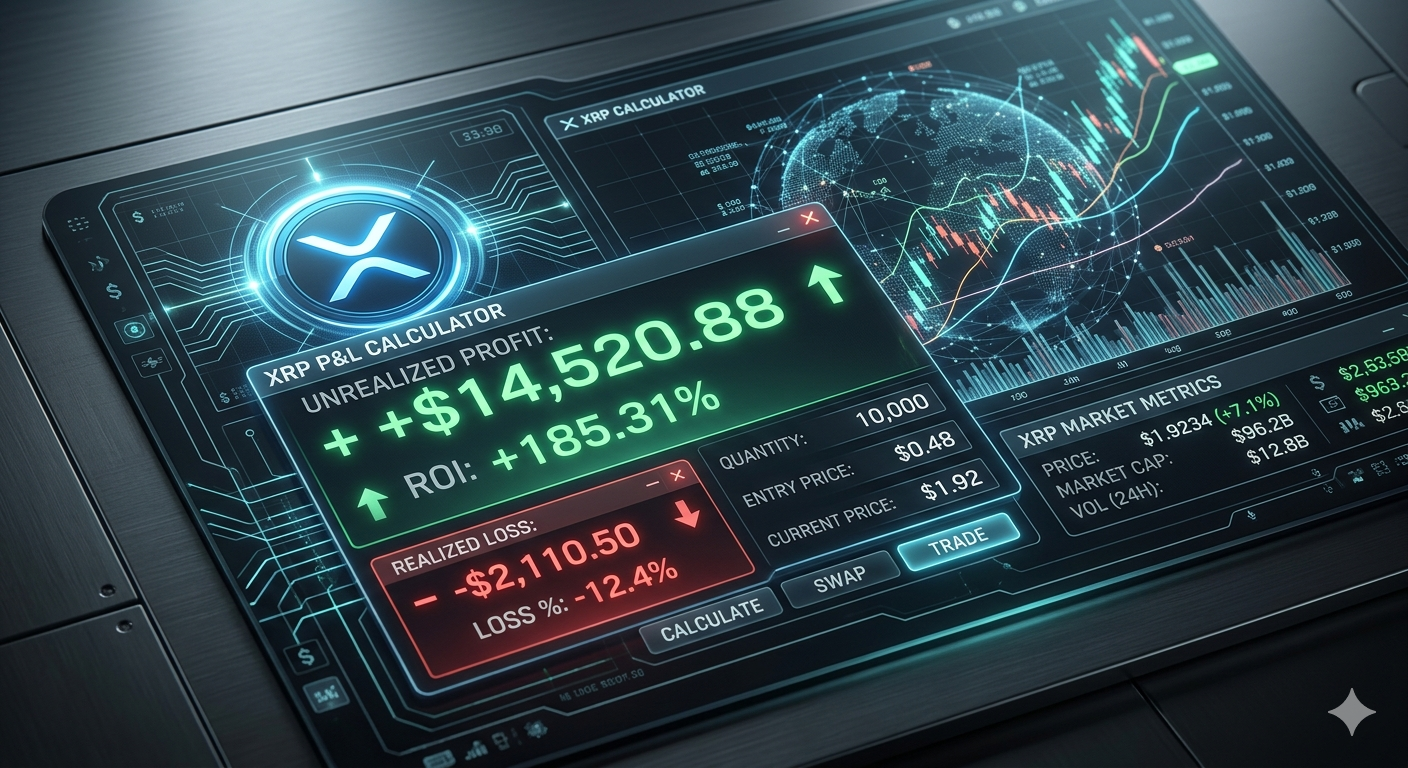
An XRP profit calculator removes the guesswork from your investment math. Instead of manually crunching numbers using complex formulas, a profit calculator gives you an instant breakdown of your total return on investment (ROI), profit or loss in dollar terms, and your net exit value after fees — all in seconds.
In this comprehensive guide, you will learn:
- Exactly how an XRP profit calculator works
- The formula behind XRP profit calculation
- Step-by-step instructions for using one correctly
- How to factor in trading fees for accurate results
- The best XRP profit-taking strategies for 2026
- How to calculate breakeven points and “what if” scenarios
- Tax implications you cannot afford to ignore
- Answers to the most frequently asked questions about XRP profits
Let us get started.
What Is an XRP Profit Calculator?
An XRP profit calculator is a free online tool that computes the financial outcome of your XRP investment based on four core inputs:
- Your initial investment amount (in USD or another fiat currency)
- Your buy price (the price of XRP when you purchased it)
- Your sell price (the price of XRP when you sold or plan to sell)
- Trading fees (optional but important for accurate results)
Once you enter these values, the calculator instantly displays your total profit or loss, your percentage ROI, the number of XRP tokens you purchased, and your net exit amount after fees are deducted.
These tools are particularly useful for:
- Short-term traders who need fast P&L calculations between trades
- Long-term holders (HODLers) who want to evaluate whether it is time to take profits
- New investors who want to model hypothetical investment scenarios before committing real money
- Tax filers who need to document capital gains and losses from XRP trades
XRP Profit Calculator
Calculate your returns instantly
The XRP Profit Calculation Formula (Explained Simply)
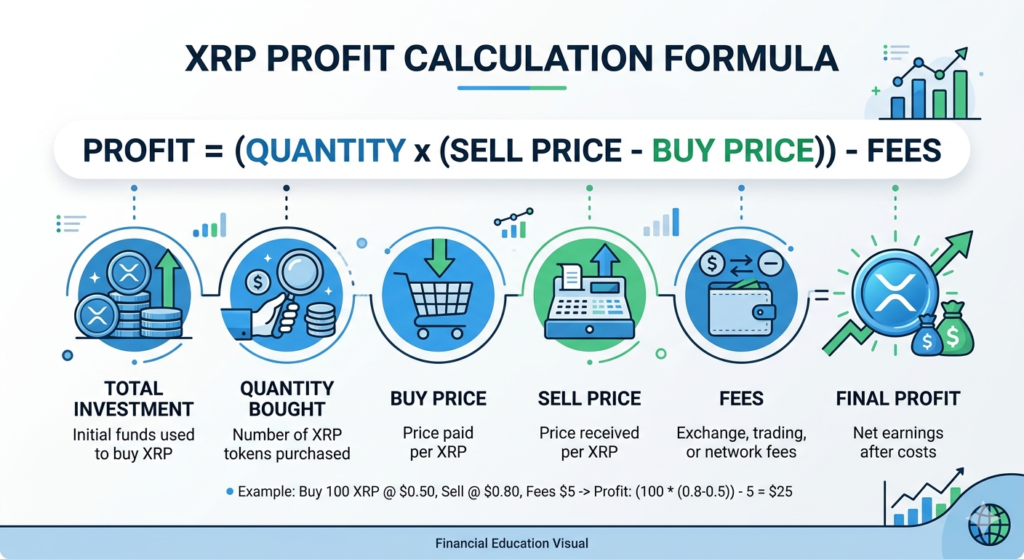
Understanding the math behind the calculator empowers you to verify results and apply the logic manually when needed. Here is the core formula used by every major XRP profit calculator:
Profit / Loss = (Initial Investment − Investment Fee) × (Sell Price ÷ Buy Price) − Initial Investment − Exit FeeExample Calculation
Let us walk through a real-world example:
- Initial Investment: $5,000
- Buy Price: $0.80 per XRP
- Sell Price: $2.00 per XRP
- Investment Fee: $50
- Exit Fee: $50
Step 1 — Calculate XRP tokens purchased: ($5,000 − $50) ÷ $0.80 = 6,187.5 XRP
Step 2 — Calculate gross exit value: 6,187.5 × $2.00 = $12,375
Step 3 — Subtract exit fee: $12,375 − $50 = $12,325
Step 4 — Calculate net profit: $12,325 − $5,000 = $7,325 profit
Step 5 — Calculate ROI percentage: ($7,325 ÷ $5,000) × 100 = 146.5% ROI
This formula is the industry standard, used by all major XRP calculators.
Step-by-Step Guide: How to Use an XRP Profit Calculator
Using an XRP profit calculator takes under 60 seconds. Here is a complete walkthrough:
Step 1 — Select XRP as Your Cryptocurrency
Most multi-coin calculators (like CoinCodex or CoinLedger) allow you to select from dozens of cryptocurrencies. Make sure XRP or Ripple is selected before proceeding.
Step 2 — Enter Your Investment Amount
Input the total dollar amount you invested. For example, if you put $2,000 into XRP, enter $2,000 in the "Investment" field. This represents your total capital commitment, not the number of tokens.
Step 3 — Enter Your Buy Price
Input the price of XRP at the time of your purchase. If you bought XRP when it was priced at $0.60, enter $0.60. The calculator will automatically determine how many XRP tokens your investment bought.
Step 4 — Enter Your Sell Price (Current or Target)
This is where you enter either the current live price of XRP (approximately $1.38–$1.44 as of April 2026) to see your current profit, or a hypothetical future price to model potential returns.
Step 5 — Add Investment and Exit Fees (Optional but Recommended)
Most exchanges charge a transaction fee between 0.1% and 0.5% per trade. Entering these fees gives you an accurate picture of your true net profit. For example, on a $5,000 investment with a 0.1% fee, your investment fee would be $5.
Step 6 — Review Your Results
The calculator will immediately display:
- Profit or Loss in USD
- Profit or Loss as a Percentage (ROI)
- Total Exit Amount
- Total Investment Amount
- Number of XRP tokens purchased
Understanding XRP's Historical Profit Performance
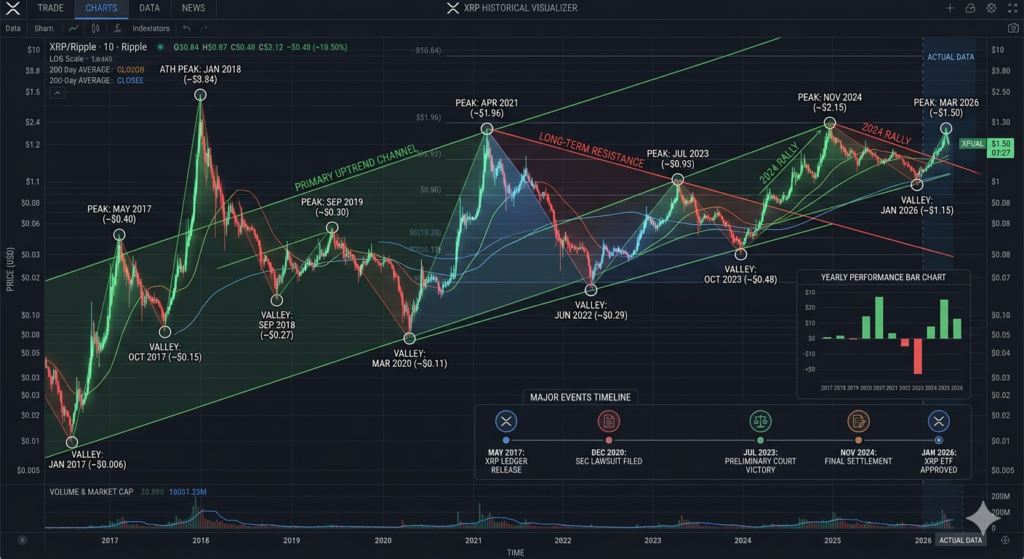
One of the most valuable features offered by calculators like CoinCodex is the historical XRP profit table, which shows annual returns going back over a decade. Here is a summary of XRP's year-by-year performance:
| Year | Opening Price | Closing Price | Annual Return |
|---|---|---|---|
| 2017 | $0.0064 | $2.27 | +35,162% |
| 2018 | $2.27 | $0.35 | −84.5% |
| 2019 | $0.35 | $0.19 | −45.4% |
| 2020 | $0.19 | $0.22 | +14% |
| 2021 | $0.22 | $0.83 | +277.9% |
| 2022 | $0.83 | $0.34 | −59.1% |
| 2023 | $0.34 | $0.62 | +82.3% |
| 2024 | $0.62 | $2.09 | +237.5% |
| 2025 | $2.09 | $1.84 | −11.75% |
| 2026* | $1.84 | ~$1.38 | −26.2% (YTD) |
2026 data through April 29, 2026
This historical context is critical for investors because it reveals XRP's extreme volatility — and its extraordinary upside potential when market conditions align. Knowing these figures helps you set realistic profit targets and avoid panic-selling during corrections.
What If I Had Invested in XRP Earlier? (Historical Scenario Calculator)
A powerful feature that calculators like CoinLedger and TokenTax offer is the "What If" calculator — a tool that lets you enter a historical investment date and amount to see what your return would be today.
For example:
- What if you invested $1,000 in XRP in January 2017? At ~$0.006 per XRP, you would have purchased roughly 166,667 XRP tokens. At today's price of ~$1.40, that investment would be worth approximately $233,333 — a staggering return.
- What if you invested $1,000 in XRP in January 2024? At ~$0.62 per XRP, you would have purchased roughly 1,613 XRP. At ~$1.40 today, your investment would be worth approximately $2,258 — a solid 125.8% return in just over 2 years.
- What if you invested $1,000 in January 2025? At ~$2.09, you would have purchased roughly 478 XRP. At ~$1.40 today, your investment is worth approximately $669 — a loss of around 33%.
These scenarios highlight why timing matters in crypto — and why having a profit calculator at your fingertips is so important for making data-driven decisions.
XRP Investment Growth Calculator: Projecting Future Returns
Beyond simple profit/loss calculation, advanced XRP calculators like CoinCodex also offer an investment growth calculator that projects the future value of your XRP holdings based on:
- Starting Investment Amount
- Monthly/Weekly/Yearly Additional Contributions
- Assumed Rate of Return (annual %)
- Time Horizon (years)
Example Projection
Suppose you invest $1,000 today with a $100 monthly contribution and assume a modest 10% annual return:
| Year | End Balance |
|---|---|
| Year 1 | $2,420 |
| Year 2 | $3,982 |
| Year 5 | $9,669 |
| Year 10 | $23,631 |
This compound growth model helps long-term investors understand the potential snowball effect of consistent XRP accumulation over time.
Important Note: These are projection models, not guarantees. Cryptocurrency markets are highly volatile. Always treat these figures as educational estimates, not financial advice.
How to Calculate Your XRP Breakeven Point
Your breakeven price is the sell price at which your profit equals zero — the minimum price XRP needs to reach for you to recover your initial investment (including fees).
The breakeven formula is:
Breakeven Price = (Investment + Investment Fee) ÷ Number of XRP Tokens PurchasedExample:
- Investment: $1,000
- Investment Fee: $5 (0.5%)
- Buy Price: $0.80
- XRP Purchased: 1,243.75 tokens
Breakeven Price = ($1,000 + $5) ÷ 1,243.75 = $0.808 per XRP
This means XRP only needs to rise from $0.80 to $0.808 for you to break even. Any price above $0.808 is pure profit.
Understanding your breakeven point helps you:
- Avoid selling at a loss accidentally
- Set realistic stop-loss levels
- Know the minimum target price before entering a trade
XRP Profit-Taking Strategies for 2026
Knowing your profit is one thing — knowing when and how to take it is another. Here are the most effective strategies used by experienced XRP investors:
1. Dollar-Cost Averaging Out (DCA Exit Strategy)
Just as Dollar-Cost Averaging (DCA) into a position reduces the risk of buying at the top, DCA-ing out of a position reduces the risk of selling at the bottom. Instead of selling all your XRP at once, sell a fixed percentage at regular intervals (weekly or monthly). This smooths out your average selling price and reduces the impact of short-term volatility.
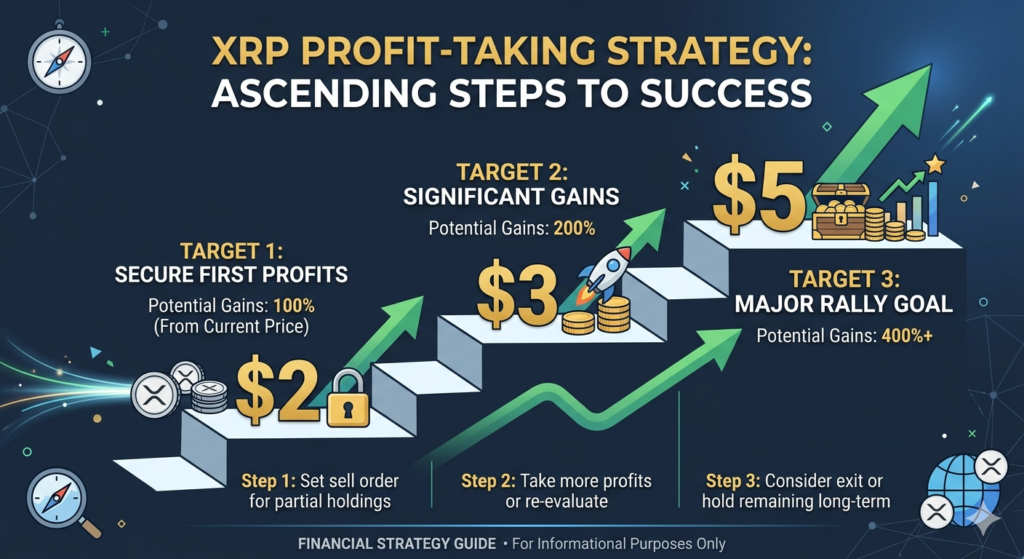
2. Percentage-Based Profit Targets
Set predefined price levels at which you sell a portion of your XRP holdings. For example:
- Sell 25% of holdings at $2.00
- Sell another 25% at $3.00
- Sell another 25% at $5.00
- Hold the remaining 25% long-term
This ensures you lock in gains at multiple price points while maintaining upside exposure.
3. Trailing Stop-Loss Orders
A trailing stop-loss automatically sells your XRP if the price drops by a set percentage from its recent peak. For example, if XRP reaches $2.50 and you set a 15% trailing stop, it will auto-sell if XRP drops to $2.125. This protects profits without requiring you to monitor the market 24/7.
4. Reinvesting Profits Strategically
Some investors choose to reinvest a portion of their XRP profits back into XRP (when prices dip) or diversify into other assets like Bitcoin, Ethereum, or even traditional stocks and real estate. As CoinLedger notes, it is important to ensure you have cash on hand to cover tax obligations before reinvesting gains.
5. Watching for Bearish Chart Signals
Experienced traders take profits when technical indicators signal a trend reversal. Key bearish signals to watch for include the death cross (50-day MA crossing below 200-day MA), shooting star candlestick patterns, and dark cloud cover formations. As of April 2026, XRP's 50-day moving average is declining while the 200-day MA is rising — a mixed signal worth monitoring closely.
XRP Profit Calculator vs. Portfolio Trackers: What's the Difference?
Many investors confuse profit calculators with portfolio trackers. Here is a quick breakdown:
| Feature | Profit Calculator | Portfolio Tracker |
|---|---|---|
| Purpose | Single trade P&L calculation | Overall portfolio performance |
| Data Input | Manual (buy/sell price, investment) | Automatic (connects to wallets/exchanges) |
| Multiple Assets | Usually limited | Yes — all holdings |
| Historical Data | "What If" scenarios | Full transaction history |
| Tax Reports | Basic (some tools) | Advanced (e.g., CoinLedger, TokenTax) |
| Best For | Quick trade analysis | Ongoing portfolio management |
For simple calculations before or after a trade, an XRP profit calculator is all you need. For comprehensive portfolio management across multiple exchanges and wallets, a full portfolio tracker like CoinLedger or TokenTax is the better choice.
Tax Implications of XRP Profits: What You Need to Know
Calculating your XRP profit is not just about knowing your gains — it directly impacts your tax liability. In most countries, including the United States, profits from selling cryptocurrency are subject to capital gains tax.
Here are the key tax concepts every XRP investor must understand:
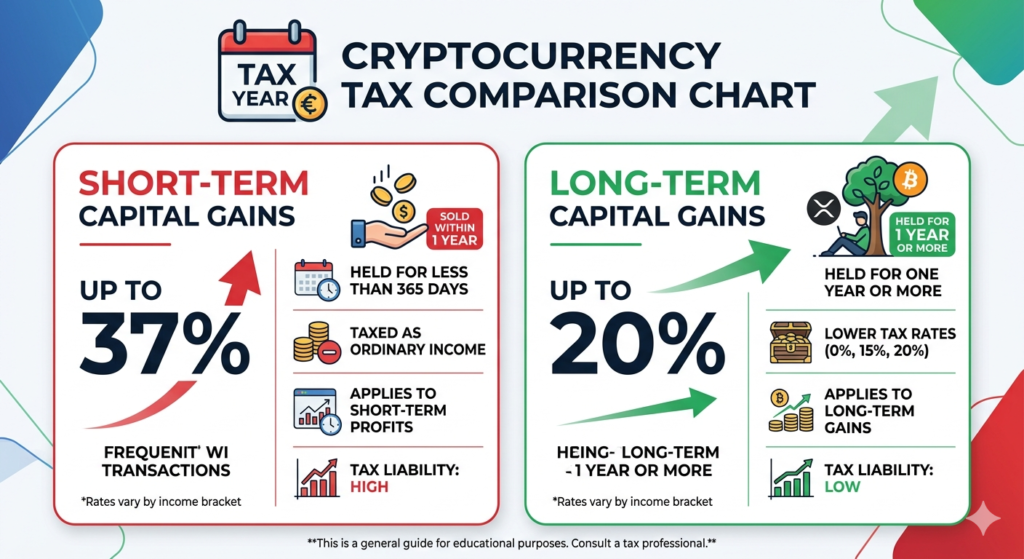
Short-Term vs. Long-Term Capital Gains
- Short-term capital gains apply to XRP held for less than one year. These are taxed at your ordinary income tax rate, which can be as high as 37% in the US.
- Long-term capital gains apply to XRP held for more than one year. These are taxed at preferential rates of 0%, 15%, or 20%, depending on your income bracket.
Strategy: Holding XRP for over 12 months before selling can significantly reduce your tax bill.
Accounting Methods: FIFO, LIFO, and Minimization
Different accounting methods calculate your cost basis differently, resulting in different taxable gains:
- FIFO (First In, First Out): Assumes your oldest XRP tokens are sold first
- LIFO (Last In, First Out): Assumes your most recently purchased tokens are sold first
- Minimization: Sells the highest-cost-basis tokens first to minimize taxable gains (offered by platforms like TokenTax)
The accounting method you choose can have a significant impact on your tax bill, especially if you have made multiple XRP purchases at different prices.
Crypto Losses Can Offset Gains
Here is something many investors miss: crypto losses are tax-deductible. If XRP dropped in value since your purchase, selling at a loss generates a capital loss that can offset other capital gains, reducing your overall tax liability. This strategy — known as tax-loss harvesting — is a powerful tool, especially in bear markets.
For detailed XRP tax guidance, consult an official resource such as the IRS Virtual Currency FAQ or work with a crypto tax professional through platforms like CoinLedger or TokenTax.
XRP Market Overview: Is Now a Good Time to Invest? (April 2026)
Before running profit projections, it is important to understand where XRP currently stands in the market.
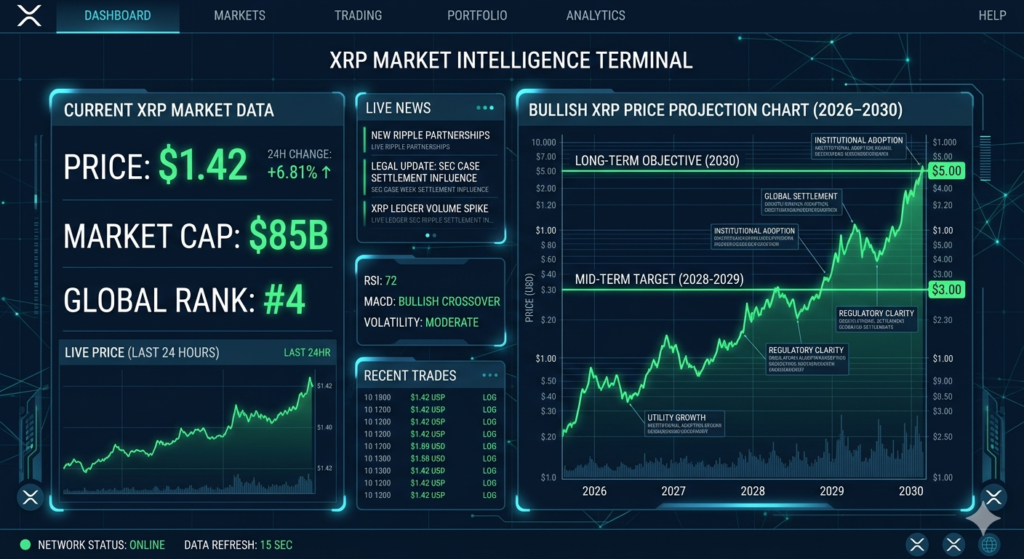
As of April 29, 2026:
- Current Price: ~$1.38–$1.44 USD
- Market Cap: ~$85–$87 billion (Ranked #4 globally)
- 24-Hour Trading Volume: ~$2 billion
- Circulating Supply: ~61.7 billion XRP
- Max Supply: 100 billion XRP
- All-Time High: $3.84 (January 4, 2018)
- 2025 High: $3.66 (July 2025)
Recent developments driving XRP sentiment in 2026 include:
- XRP Spot ETFs: The SEC approved the first wave of XRP spot ETFs in November 2025, with Bitwise, Grayscale, 21Shares, Canary Capital, and Franklin Templeton among the major issuers. XRP ETFs attracted $75.6 million in April 2026 alone — the highest monthly inflow of 2026.
- Institutional Adoption: Ripple recently partnered with South Korea's Kyobo Life Insurance to tokenize government bond settlements, with the deal targeting near-real-time settlement.
- CLARITY Act: Ripple's CEO has anticipated the CLARITY Act's passage by the end of May 2026, which could significantly clarify XRP's regulatory status in the United States.
- XRPL Innovation: Zero-Knowledge proof verification was integrated into the XRP Ledger in April 2026, enabling private, compliant institutional DeFi transactions.
Most analyst forecasts for XRP in 2026 cluster between $2.50 and $5.00, with Standard Chartered projecting approximately $2.80 under moderate conditions and more bullish models pointing toward $5.00 in strong bull scenarios.
Tips for Getting the Most Accurate Results from an XRP Profit Calculator
To ensure your XRP profit calculator gives you precise, actionable numbers, follow these best practices:
Always include trading fees. Most exchanges charge between 0.1% and 0.5% per transaction. On larger investments, these fees can amount to hundreds of dollars — a significant difference in your actual net profit.
Use accurate historical buy prices. When calculating past trades, use the actual price at which you purchased XRP, not approximate figures. You can find exact historical prices on platforms like CoinMarketCap or CoinGecko.
Account for multiple purchases separately. If you bought XRP at different times and prices, calculate each purchase as a separate entry for maximum accuracy.
Use live price data. For calculating current (unrealized) gains, make sure the sell price field reflects the current live market price of XRP, which updates in real time on most major platforms.
Model multiple scenarios. Do not just calculate at one target price. Use the calculator to model multiple exit scenarios — conservative, moderate, and bullish — so you have a clear picture of outcomes under different market conditions.
Frequently Asked Questions About XRP Profit Calculators
Use the formula: Profit = (Investment − Investment Fee) × (Sell Price ÷ Buy Price) − Investment − Exit Fee. Or simply plug your numbers into a free online XRP profit calculator like CoinCodex or CoinLedger for an instant result.
There is no universal "good" ROI for XRP. It depends on your investment timeline, risk tolerance, and goals. Historically, XRP has delivered returns ranging from −84% (2018) to +35,162% (2017). Many long-term investors measure their XRP returns against the S&P 500's historical average annual return of approximately 11.88%.
Yes, in most jurisdictions including the United States, profits from selling XRP are subject to capital gains tax. Short-term gains (held under 1 year) are taxed at ordinary income rates; long-term gains (held over 1 year) receive preferential tax rates.
Yes. Most calculators allow you to enter a historical buy price to calculate what your profit or loss would have been on a past trade. Some platforms like CoinLedger also offer a "What If" calculator that uses historical date-based pricing data automatically.
The best profit-taking percentage is highly subjective and depends on your individual financial goals and risk tolerance. A common approach is to take profits in increments — selling 20–25% of your position at each significant price milestone — to lock in gains while maintaining upside exposure.
Most basic XRP profit calculators do not account for staking or yield rewards. For a comprehensive view that includes all income sources from your XRP holdings, use a full portfolio tracker with tax reporting capabilities.
If the sell price you enter is lower than your buy price, the calculator will show a loss instead of a profit, expressed in both dollar terms and as a negative percentage ROI. This helps you understand your downside risk before executing a trade.
Conclusion: Start Calculating Your XRP Profits Today
An XRP profit calculator is one of the most practical and powerful tools in any crypto investor's toolkit. Whether you are checking on an existing position, planning your next entry point, or modeling what your XRP could be worth at $5, $10, or beyond — having instant access to accurate profit and loss figures puts you in control of your financial decisions.
The key takeaways from this guide:
- The core profit formula is: (Investment − Fee) × (Sell ÷ Buy) − Investment − Exit Fee
- Always include trading fees for accurate results
- XRP has delivered extraordinary historical returns — and significant losses — so risk management is essential
- DCA exit strategies and percentage-based profit targets are the most reliable ways to lock in gains
- All XRP profits are subject to capital gains tax — track your trades and consult a crypto tax professional
- The XRP market in 2026 is supported by ETF inflows, institutional adoption, and potential regulatory clarity — but volatility remains the norm
Disclaimer: This article is for informational and educational purposes only and does not constitute financial or investment advice. Cryptocurrency investments carry significant risk. Always conduct your own research and consult with a qualified financial advisor before making investment decisions.
Visit Here to see all the Prices of Every Currency.