

Did you know that over 420 million people worldwide own some form of cryptocurrency — yet the majority of them have no idea whether they are actually making a profit or a loss? Whether you just bought your first Bitcoin, swing-trade Ethereum every week, or hold a diverse portfolio of 20 altcoins, one thing is absolutely essential: knowing your exact numbers.
A crypto calculator is the single most important free tool every cryptocurrency investor needs. It eliminates guesswork, removes emotional decision-making, and gives you instant clarity on your investment returns, trading fees, and even potential tax liability — all in seconds.
In this complete 2025 guide, we will explain exactly what a crypto calculator is, how crypto profit calculations work (with real formulas and examples), how to use one step-by-step, and everything else you need to know to make smarter, data-driven investment decisions.
💰 Crypto Profit Calculator
Calculate your real profit/loss with live market prices & fees
What Is a Crypto Calculator?
A crypto calculator — also called a cryptocurrency profit calculator or crypto P&L calculator — is a free online tool that helps investors instantly determine the profit or loss from any cryptocurrency trade or investment.
At its most basic level, a crypto calculator takes four simple inputs:
- The amount of money you originally invested
- The price at which you bought the cryptocurrency
- The current price (or price at which you sold)
- Any fees paid during buying or selling
From these inputs, it calculates your net profit or loss, your return on investment (ROI) as a percentage, the total value of your exit position, and in advanced versions, your estimated tax liability.
Unlike stock market tools, crypto calculators must account for the extreme price volatility of digital assets. Bitcoin, for example, has moved from $3,800 in March 2020 to over $69,000 in November 2021, and back down below $16,000 by late 2022 — only to rise above $100,000 in 2024. Calculating exact profits in such a volatile environment without a dedicated tool is nearly impossible to do accurately.

Why Every Crypto Investor Needs a Profit Calculator
Many beginner investors believe they are making money simply because the price of their coin went up. But price increase alone does not equal profit. Here is why a dedicated crypto calculator is indispensable:
1 Accurate Profit Tracking
Crypto markets operate 24/7 across hundreds of exchanges with different prices, fees, and spreads. Without a calculator, it is nearly impossible to track exactly what you paid, what you received, and what you actually earned after all costs.
2 Fee Awareness
Trading fees can silently eat into your profits. Binance charges 0.1% per trade, Coinbase Pro charges up to 0.6%, and some decentralized exchanges charge 0.3% or more in liquidity fees. On a $10,000 trade, that can be $30–$60 per transaction — and across dozens of trades, it can destroy your returns.
3 Tax Compliance
In most countries, cryptocurrency gains are taxable. In the United States, for example, the IRS treats crypto as property, meaning every sale or trade is a taxable event. A crypto profit calculator gives you the exact gain figures needed to report accurately. According to IRS.gov, failure to report crypto gains can result in penalties and audits.
4 Emotional Discipline
When prices are falling, panic selling is the enemy of long-term wealth. Knowing your exact break-even price — which a crypto calculator shows instantly — helps you make rational decisions instead of emotional ones.
5 Portfolio Optimization
By comparing ROI across different coins in your portfolio, you can identify which investments are performing best and reallocate capital intelligently.
The Crypto Profit Formula Explained (With Real Examples)
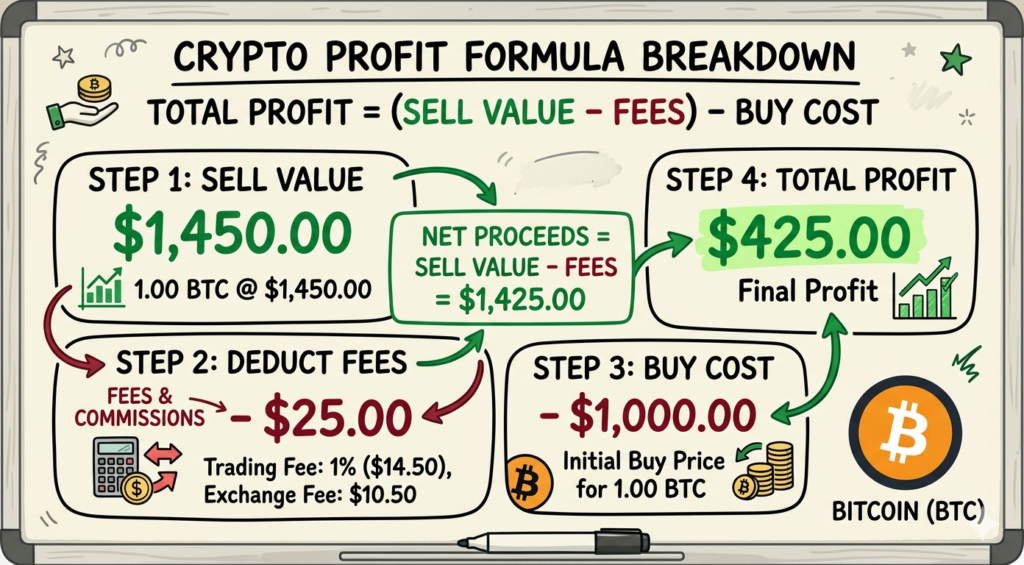
Understanding the math behind a crypto calculator is essential. Here is the exact formula used by the top tools:
CRYPTO PROFIT FORMULA:Profit/Loss = (Investment − Buy Fee) × (Sell Price ÷ Buy Price) − Investment − Sell Fee
Step-by-Step Example
Let us say you invested $5,000 in Bitcoin when BTC was trading at $25,000. You paid a 0.1% buy fee ($5). Bitcoin later rose to $40,000 and you sold, paying another 0.1% exit fee ($8)
- Initial Investment: $5,000
- Buy Price: $25,000
- Sell Price: $40,000
- Buy Fee: $5 (0.1%)
- Sell Fee: $8 (0.1%)
Calculation: ($5,000 − $5) × ($40,000 ÷ $25,000) − $5,000 − $8 = $2,979.20 net profit (≈ 59.6% ROI)
Without the fee deductions, you might have estimated $3,000 profit — a $20.80 error that compounds significantly across many trades.
ROI Percentage Formula
Return on investment (ROI) as a percentage is calculated as:
ROI% = (Net Profit ÷ Initial Investment) × 100
In our example: ($2,979.20 ÷ $5,000) × 100 = 59.58% ROI
How to Use a Crypto Calculator: Step-by-Step Guide
Using an online crypto calculator takes less than 60 seconds. Here is an exact walkthrough:
- Choose Your Cryptocurrency: Select the coin you traded (e.g., Bitcoin, Ethereum, Solana, or any altcoin)
- Enter Your Investment Amount: Type the total amount of money you invested in your local currency (USD, EUR, GBP, etc.)
- Enter the Buy Price: The price per coin at the time you purchased
- Enter the Sell Price: The current price or the price at which you sold
- Add Investment Fee (Optional): The trading fee your exchange charged when you bought
- Add Exit Fee (Optional): The trading fee charged when you sold
- View Your Results: The calculator instantly shows your profit/loss, ROI percentage, and total exit value
Pro Tip: Always include fees — even small percentages can dramatically reduce actual profits, especially for high-frequency traders or large positions.
Types of Crypto Calculators Available in 2025
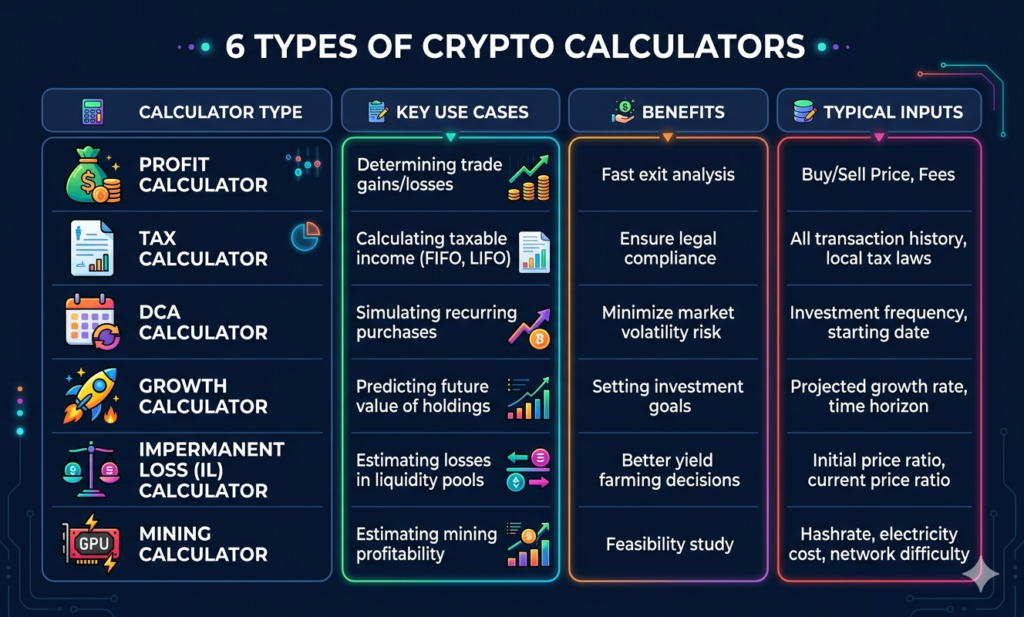
Not all crypto calculators are the same. Here are the main types you should know about:
1 Crypto Profit/Loss Calculator
The most common type. You input buy price, sell price, investment, and fees to get instant P&L and ROI. This is the standard tool covered in this guide.
2 Crypto Tax Calculator
These tools integrate with exchange APIs to automatically import your trade history and calculate capital gains tax liability across all your transactions. Tools like CoinLedger and Koinly specialize in this area.
3 Dollar-Cost Averaging (DCA) Calculator
A DCA crypto calculator shows what would have happened if you had invested a fixed amount (say $100) every week or month in a specific coin over a set period. This is extremely powerful for long-term investors to understand compounding returns.
4 Crypto Investment Growth Calculator
Also called a future value calculator, this type lets you project what your investment could be worth in 5, 10, or 20 years based on an assumed annual growth rate. According to CoinCodex research, historical crypto market cap data shows average yearly growth has been dramatic — though highly variable.
5 Impermanent Loss Calculator
Specifically for DeFi (Decentralized Finance) liquidity providers, this calculates the impermanent loss you experience when providing liquidity to automated market makers like Uniswap or PancakeSwap.
6 Crypto Mining Profitability Calculator
Miners use these to calculate whether mining a specific cryptocurrency is profitable based on hash rate, electricity cost, hardware efficiency, and current coin price. Sites like WhatToMine specialize in this.
How to Factor In Trading Fees Correctly
Trading fees are the silent profit killers that most beginner investors overlook. Here is a comprehensive breakdown of fees you need to account for when calculating true crypto profit:
Exchange Trading Fees
Most centralized exchanges charge a maker/taker fee model. Typical rates in 2025:
- Binance: 0.10% maker / 0.10% taker (lower with BNB discounts)
- Coinbase: 0.40%–0.60% for standard users
- Kraken: 0.16%–0.26% depending on volume
- Bybit: 0.10% maker / 0.10% taker
Network/Gas Fees
On-chain transactions (especially on Ethereum) require paying gas fees, which can range from a few cents to over $50 during network congestion. These are always subtracted from your profit.
Withdrawal Fees
Exchanges charge flat fees to withdraw crypto to external wallets. For example, withdrawing BTC from Binance costs approximately 0.0005 BTC in 2025.
Spread Costs
Some exchanges, particularly those targeting beginners, do not charge explicit fees but instead make money on the spread — the difference between the buy and sell price. This is an implicit fee that many investors never notice but should always include in calculations.
Crypto Tax Calculator: Do You Owe Taxes on Your Profits?
This is one of the most critical — and most ignored — aspects of crypto investing. In most major jurisdictions, cryptocurrency profits are subject to capital gains tax.
United States
The IRS classifies cryptocurrency as property. Per IRS Notice 2014-21, every time you sell, trade, or use crypto to buy goods/services, it is a taxable event. Short-term gains (held less than 12 months) are taxed at ordinary income rates (10%–37%). Long-term gains (held over 12 months) are taxed at 0%, 15%, or 20% depending on your income bracket.
United Kingdom
HMRC treats crypto as a capital asset. You pay Capital Gains Tax on profits above the annual CGT allowance (£3,000 in 2025). Rates are 10% for basic rate taxpayers and 20% for higher rate taxpayers.
European Union
Tax treatment varies by country. Germany, for example, exempts crypto gains from tax if held for more than one year. France applies a flat 30% tax on crypto gains. Always consult a local tax professional.
How a Crypto Tax Calculator Helps
Advanced crypto tax tools automatically import your trade history from exchanges via API, apply the correct cost-basis method (FIFO, LIFO, HIFO), calculate your net capital gains, and generate tax reports ready for filing. The IRS reports that crypto tax compliance is a growing enforcement priority, with over $10 billion in crypto tax evasion identified.

Bitcoin Profit Calculator vs. Altcoin Profit Calculators
While the underlying formula for calculating profit is the same for all cryptocurrencies, there are key differences between calculating Bitcoin profits and altcoin profits that investors need to understand:
Bitcoin Profit Calculator
Bitcoin is the most liquid and most stable (relatively) major cryptocurrency. Key considerations include:
- Bitcoin price is quoted in USD on all major exchanges — straightforward to calculate
- Bitcoin-only pairs (BTC/USDT, BTC/USD) make fee calculation simple
- Long-term holders (HODLers) benefit from favorable long-term capital gains tax rates
- Bitcoin halving cycles significantly affect price — smart investors track these when projecting profits
Altcoin Profit Calculator
Altcoins add complexity to profit calculations:
- Many altcoins are purchased with BTC or ETH first, creating a double-conversion profit calculation
- Liquidity is lower, meaning larger spreads that increase your effective entry cost
- Altcoins can go to zero — always calculate worst-case scenario as well as best case
- Some altcoins offer staking rewards, which should be added to total profit
Dollar-Cost Averaging (DCA) Crypto Calculator
Dollar-cost averaging is the strategy of investing a fixed dollar amount at regular intervals, regardless of price. It is one of the most powerful strategies for reducing the impact of volatility on your portfolio.
A DCA crypto calculator answers the critical question: “What if I had invested $100 every month in Bitcoin for the last 3 years?”
Example DCA Calculation
Suppose you invested $200 every month in Ethereum from January 2022 to December 2024 (36 months):
- Total invested: $7,200
- Average buy price: Variable (across bear and bull market)
- Approximate portfolio value at end of 2024: ~$14,000–$18,000 (depending on exact timing)
- Approximate ROI: 95%–150%
DCA significantly outperforms lump-sum investing in volatile markets by eliminating the impossible task of “timing the bottom.” According to research cited by Investopedia, DCA reduces average cost per unit and emotional investing behavior simultaneously.

Common Mistakes When Calculating Crypto Profit
Even experienced investors make these costly errors when calculating crypto profits. Avoid them all:
Mistake 1: Ignoring Fees
As shown in our formula above, even a 0.1% fee on both sides of a trade reduces your net profit. On a $50,000 trade, that is $100 in fees that most people forget to deduct.
Mistake 2: Forgetting Currency Conversion
If you purchased crypto using EUR, GBP, or another non-USD currency, you must account for the exchange rate at both purchase and sale to calculate true profit in your home currency.
Mistake 3: Not Counting Unrealized vs. Realized Profit
Unrealized profit (paper gain) is the profit you would make if you sold right now — but it is not actual profit until you sell. Many investors confuse paper gains with real wealth, which leads to poor decision-making.
Mistake 4: Overlooking Staking/Yield Income
If you staked your crypto and earned rewards, those rewards are additional taxable income in most jurisdictions — not just capital gains. Failing to include staking income in your total return calculation gives an incomplete picture.
Mistake 5: Using the Wrong Cost Basis Method
If you bought the same coin multiple times at different prices, which purchase price do you use? FIFO (First In, First Out), LIFO (Last In, First Out), and HIFO (Highest In, First Out) give different profit and tax results. Using the wrong method can overstate or understate your tax liability.
11. Best Free Crypto Calculators in 2025: Comparison
After analyzing all the top tools, here is our expert comparison of the best free crypto calculators available in 2025:
| Tool | Best For | Key Feature | Pricing |
|---|---|---|---|
| CoinLedger | Tax reporting + P&L | Auto tax reports, 700K+ users | Free calculator, paid tax reports |
| CoinStats | Portfolio tracking | 1M+ active users, wallet connect | Free + Premium plans |
| CoinCodex | Historical data + DCA | 15-year market cap table | Free |
| CryptoProfitCalculator.com | Simple quick calc | Dedicated domain, clean UI | Completely free |
| CoinDCX | India-focused investors | INR currency support | Free |
Each tool has its strengths. CoinLedger excels for US tax compliance. CoinStats is best for real-time portfolio tracking. CoinCodex offers the deepest data for research-oriented investors.
Frequently Asked Questions About Crypto Calculators
A crypto profit calculator is 100% mathematically accurate as long as you input the correct values. The formula is straightforward: it calculates profit based on the exact numbers you provide. The risk of inaccuracy comes only from entering incorrect buy/sell prices or forgetting to include fees.
Yes, but with limitations. A basic crypto profit calculator can tell you your capital gain on a single trade. For full tax compliance, especially if you have made dozens or hundreds of trades, you need a dedicated crypto tax calculator that imports all your transaction history automatically.
Given the volatility of the crypto market, most experienced investors consider any positive annual ROI as acceptable for a conservative strategy. However, Bitcoin has historically delivered annualized returns of 100%+ over multi-year periods. For short-term trading, professional traders target 5%–20% per trade while managing risk carefully.
You can recreate the crypto profit formula in Excel using the following formula in a cell: =(D2-B2)*C2-(B2*E2)-(D2*C2*F2) — where D2=sell price, B2=buy price, C2=number of coins, E2=buy fee %, and F2=sell fee %. However, using a dedicated crypto calculator tool is faster and less error-prone.
Yes, in most jurisdictions including the United States, a taxable event occurs at the time of the trade, not when you withdraw funds to your bank account. Even if you sold Bitcoin for Ethereum (a crypto-to-crypto trade), that is a taxable event in the US. Always consult a tax professional familiar with cryptocurrency for your specific situation.
Your break-even price is the price at which your crypto investment returns exactly what you paid, including all fees. Formula: Break-even Price = (Investment + Buy Fee) ÷ Number of Coins Purchased. A good crypto calculator always shows this figure prominently.
Yes, most modern crypto calculators support multiple currencies including USD, EUR, GBP, AUD, INR, and many others. Simply select your preferred fiat currency before running the calculation.

Final Verdict: Start Calculating Your Crypto Profits Today
Whether you are a complete beginner who just bought your first $50 worth of Bitcoin, or an experienced trader managing a six-figure portfolio, a crypto calculator is non-negotiable. It gives you the financial clarity that every smart investor needs: exact profit figures, true ROI, fee impact analysis, break-even prices, and tax liability estimates.
The difference between investors who build lasting wealth from cryptocurrency and those who lose money is not just which coins they pick — it is whether they truly understand their numbers. A crypto calculator bridges that knowledge gap in seconds.
Here is a quick action plan to get started:
- Bookmark a reliable free crypto calculator (the ones listed in Section 11 are excellent starting points)
- Calculate your exact profit or loss on every trade you make — no exceptions
- Always include trading fees in every calculation, on both buy and sell sides
- Track your break-even price so you always know your true floor
- Consult a crypto tax calculator at least quarterly if you are an active trader
For more comprehensive information on crypto investing strategies, check out the CoinMarketCap guide to crypto investing and the official IRS guidance on virtual currency taxation for tax-related decisions.
Try Our More Tools For Calculate profit and loss.