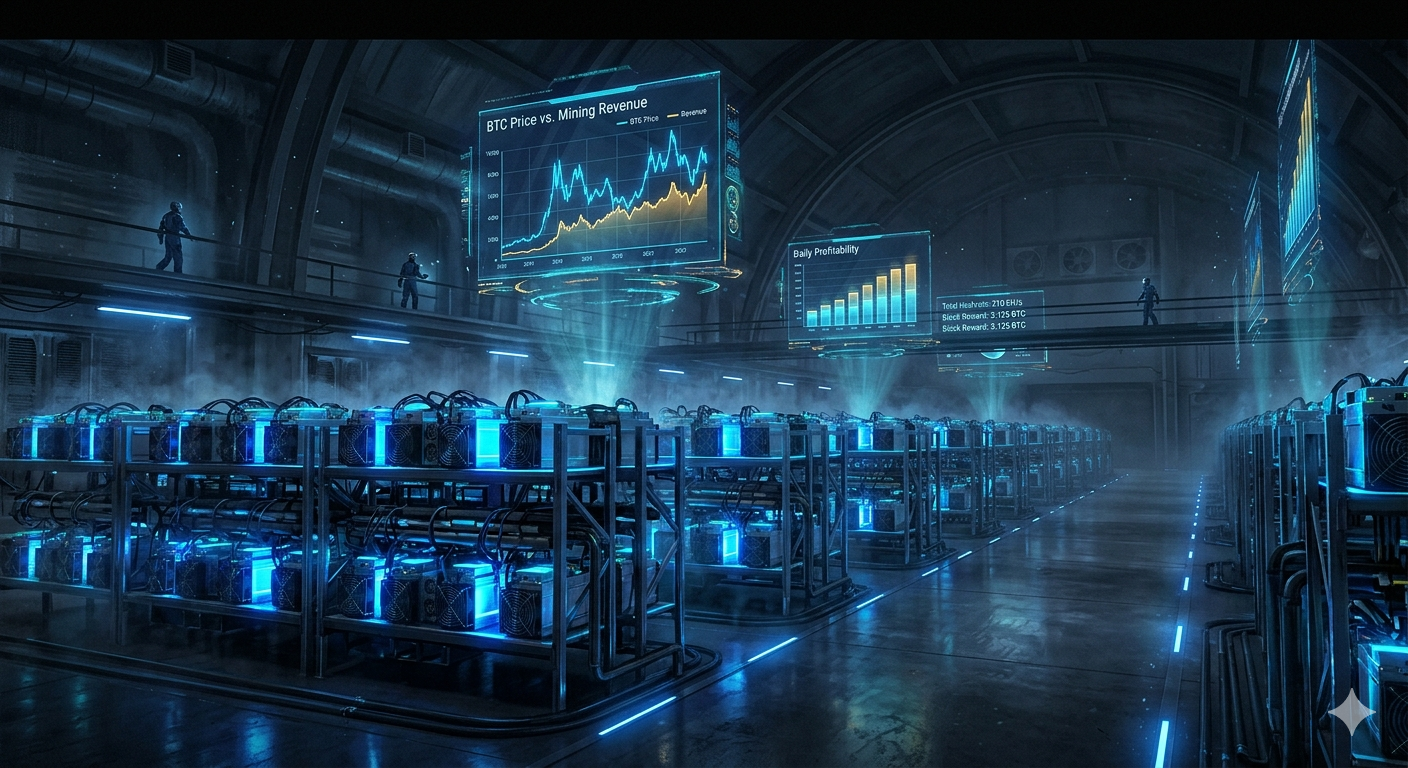
What Is a BTC Mining Calculator?
A BTC mining calculator is an online tool that helps miners estimate how much Bitcoin they can earn — and whether that earning will exceed their costs. By entering a few key inputs like your mining hardware’s hashrate, electricity consumption, and your local electricity price, these calculators crunch the numbers and show you projected daily, weekly, monthly, and yearly profits.
Whether you’re a solo miner running a single Antminer at home or a large-scale operation managing hundreds of ASIC rigs, a Bitcoin mining calculator is the first tool you should reach for before spending a single dollar on hardware or electricity.
Unlike guessing or relying on outdated data, a proper BTC mining calculator uses live network data — including the current Bitcoin price, network hashrate, block reward, and mining difficulty — to give you a realistic picture of what your mining setup can actually earn.
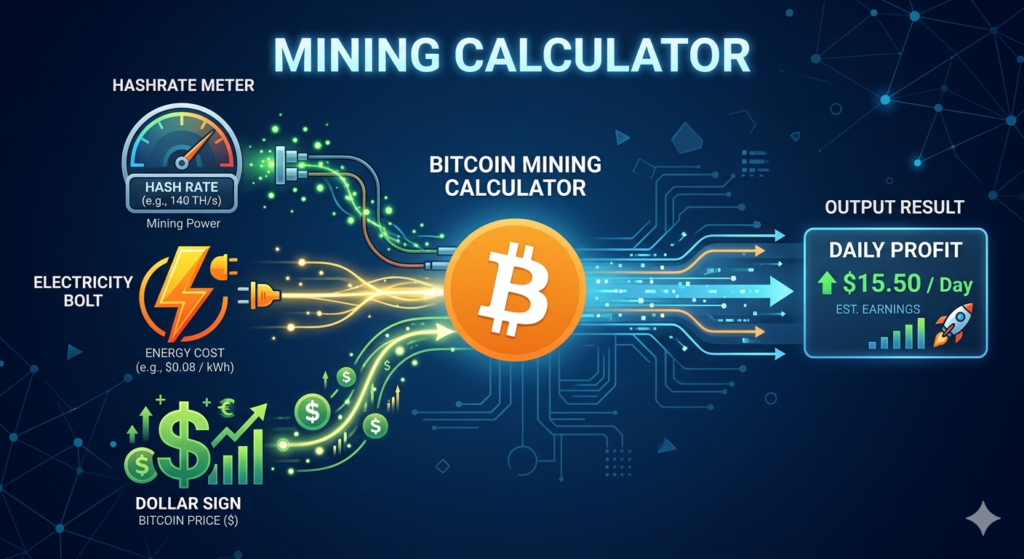
How Does a Bitcoin Mining Calculator Work?
At its core, a BTC mining calculator uses a straightforward formula:
Profit = Revenue − Electricity Cost − Pool Fee
But under the hood, the math is more complex. Here’s what’s actually happening:
Revenue calculation is based on your share of the total network hashrate. If the entire Bitcoin network is producing 978 EH/s (exahashes per second), and your miner produces 110 TH/s, you control a tiny but real fraction of that network. The calculator uses this to estimate how many blocks — and therefore how much BTC — you’ll mine per day.
Block reward is currently 3.125 BTC per block after the April 2024 halving. With approximately 144 blocks mined per day, the total daily BTC reward is around 450 BTC split among all global miners.
Difficulty adjustment happens every 2,016 blocks (roughly every two weeks). If more miners join the network, difficulty rises, making it harder to find a block and reducing each miner’s individual yield. The best calculators factor in projected difficulty growth, not just today’s snapshot.
Electricity cost is subtracted from your revenue. It is calculated as:Electricity Cost = (Power in Watts ÷ 1000) × Hours × Price per kWh
The result: your estimated net profit over any time period you choose. See lives Prices of Differnet Currency.
⛳ BTC Mining Calculator
Estimate your Bitcoin mining profit — updated with live network data
| Period | BTC Mined | Revenue | Electricity | Pool Fee | Net Profit |
|---|
Key Inputs You Need to Use a BTC Mining Calculator
To get an accurate result from any Bitcoin mining calculator, you’ll need the following information ready:
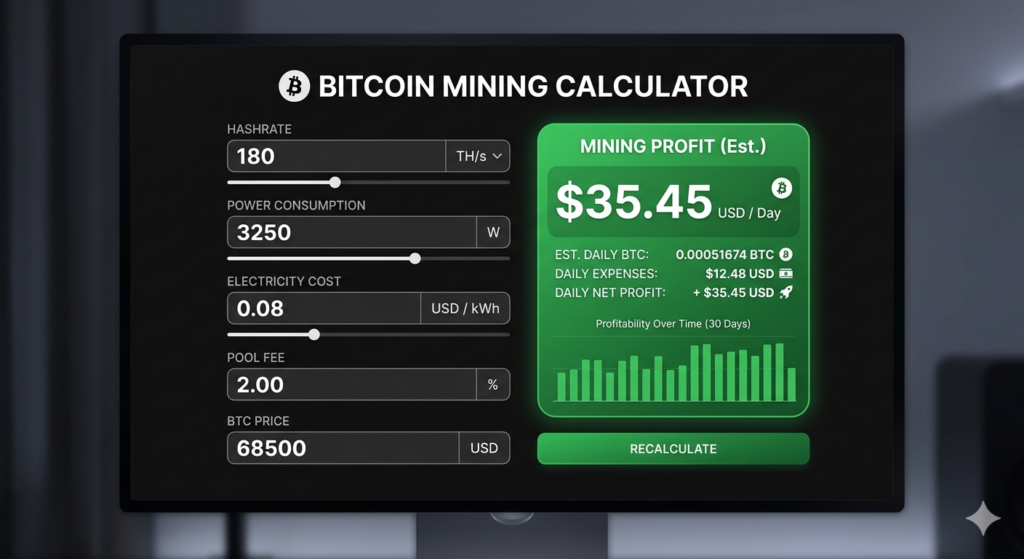
Hashrate (TH/s, GH/s, or PH/s): This is how fast your mining hardware processes SHA-256 calculations. Most modern ASIC miners operate in the TH/s range. For example, the Bitmain Antminer S21 Pro delivers around 234 TH/s.
Power Consumption (Watts): Every ASIC miner has a rated power draw. The Antminer S21 Pro consumes approximately 3,510 watts. This directly impacts your electricity bill.
Electricity Cost ($/kWh): This is your local cost of electricity per kilowatt-hour. The global average is around $0.08–$0.12/kWh, though industrial miners often secure rates below $0.05/kWh to stay competitive.
Pool Fee (%): Most miners join mining pools and pay a small percentage fee — typically 1–3% — to the pool operator in exchange for more consistent (if smaller) payouts.
Hardware Cost (optional): Some advanced calculators allow you to enter your upfront hardware cost so you can calculate your break-even point — the date when cumulative profits exceed your initial investment.
Bitcoin Price (USD): The current BTC price is auto-populated in most calculators but can be manually adjusted to model different price scenarios.
How to Calculate Bitcoin Mining Profitability: Step-by-Step
Here’s how to run the numbers yourself using any BTC mining calculator:
Step 1 — Find your miner’s specs. Check the manufacturer’s website or the product listing for your ASIC’s hashrate (TH/s) and power consumption (W). If you don’t own hardware yet, most calculators let you select from a preloaded hardware list.
Step 2 — Check your electricity rate. Look at your electricity bill to find your cost in $/kWh. If you’re planning a mining operation, negotiate commercial rates or explore hosting services.
Step 3 — Enter your pool fee. If you’re mining with a pool (recommended for most miners), check your pool’s fee structure. F2Pool, Antpool, and ViaBTC typically charge around 1–2.5%.
Step 4 — Hit calculate. The calculator will instantly show your estimated daily, monthly, and yearly revenue, costs, and profit — all based on real-time Bitcoin network data.
Step 5 — Model scenarios. Try adjusting the BTC price up and down (e.g., $60,000 vs. $100,000) to understand your risk exposure. Also check the break-even electricity rate — this tells you the maximum $/kWh at which your operation stays profitable.
Factors That Affect Bitcoin Mining Profitability
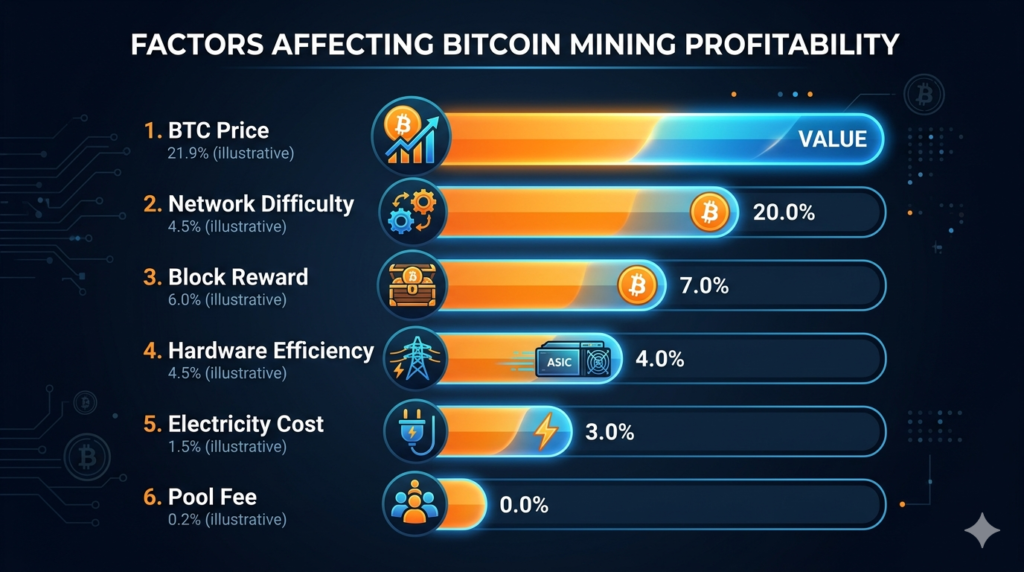
Understanding the calculator output requires knowing what drives those numbers. Here are the most important variables:
Bitcoin Price
The most volatile factor. BTC’s price directly multiplies your revenue. At $77,000 BTC, a miner earning 0.00018 BTC/day makes roughly $13.86/day. At $150,000 BTC, the same miner earns ~$27/day — without changing a single wire.
Network Hashrate and Difficulty
As of April 2026, the Bitcoin network hashrate sits around 978 EH/s. As more miners come online, your proportional share shrinks. Difficulty adjusts to maintain a 10-minute block time regardless of how many miners are active globally. This is why most reputable calculators factor in an average daily hashrate growth rate of approximately 0.05% — because your share of the network diminishes every day.
Block Reward (Halving)
Bitcoin’s block reward halves approximately every four years. The most recent halving in April 2024 cut the reward from 6.25 BTC to the current 3.125 BTC. The next halving is expected around 2028, dropping the reward to 1.5625 BTC. This has a direct downward pressure on mining revenue — unless BTC price rises correspondingly.
Hardware Efficiency (J/TH)
Efficiency is measured in joules per terahash (J/TH). The lower the number, the more hash you get per watt. Top-tier 2026 miners like the Bitmain Antminer S21+ achieve efficiency around 15–17 J/TH. Older hardware above 30 J/TH is increasingly difficult to run profitably.
Electricity Cost
This is the single most controllable factor in long-term mining profitability. Industrial miners in regions with cheap hydro or geothermal power (Iceland, parts of the US Pacific Northwest, parts of Central Asia) operate at $0.02–$0.04/kWh, giving them enormous margins even during bear markets.
Pool Fees
A 1% fee sounds small, but over a full year on a large mining farm, it adds up. Always compare pool fees against payout reliability and pool luck statistics.
Is Bitcoin Mining Profitable in 2026?
The honest answer: it depends entirely on your electricity cost and hardware efficiency.
With BTC trading around $76,000–$77,000 and the network hashrate near an all-time high of 978 EH/s, profit margins for high-electricity-cost miners have compressed significantly. A miner paying $0.12/kWh with 2023-era hardware may be operating at a loss. A miner with sub-$0.05/kWh electricity and a top-tier 2025/2026 ASIC is still highly profitable.
Here’s a quick snapshot based on current network conditions:
Scenario A — Industrial Miner (Antminer S21 Pro, $0.04/kWh):
- Revenue: ~$15–16/day per unit
- Electricity: ~$3.37/day
- Net Profit: ~$11–12/day ✅ Profitable
Scenario B — Home Miner (Antminer S19j Pro, $0.12/kWh):
- Revenue: ~$7–8/day
- Electricity: ~$7.20/day
- Net Profit: ~$0–1/day ⚠️ Breakeven or loss
The key takeaway: electricity cost is the single biggest determinant of whether BTC mining is worth it for you in 2026. Before buying hardware, always run your specific numbers through a calculator.
For further reading on Bitcoin’s fundamental metrics and network health, the Bitcoin Wiki provides excellent background on how the SHA-256 proof-of-work algorithm drives mining operations. You can also track live Bitcoin difficulty changes at blockchain.com.
Tips to Maximize Your BTC Mining Profits
1. Prioritize electricity cost above all else. Even modest hardware becomes profitable with cheap electricity. Research regions, co-location services, and behind-the-meter renewable setups.
2. Choose the right hardware. In 2026, efficiency below 20 J/TH is the target. Research the latest Antminer and Whatsminer releases before purchasing. Avoid secondhand hardware with high J/TH ratios.
3. Join a reputable mining pool. Solo mining with consumer-level hardware means you could wait months or years to mine a block. Pools like Foundry USA, F2Pool, and Antpool provide steady, proportional payouts. Compare their fee structures carefully.
4. Model multiple BTC price scenarios. Don’t plan for one price. Run your calculator at $60,000, $80,000, and $120,000 BTC to understand your full risk range. Know your break-even price before you invest.
5. Monitor your mining operation. Use monitoring software like Minerstat or Hive OS to track uptime, efficiency, and temperature. Downtime is lost money.
6. Reinvest strategically. As older hardware becomes unprofitable, reinvest into newer, more efficient models. The miners who stay profitable long-term are those who treat mining as a business and continuously upgrade.

Frequently Asked Questions (FAQ)
Bitbo’s Bitcoin mining calculator is widely considered among the most accurate because it accounts for the daily network hashrate growth rate (~0.0533% per day), which most other calculators ignore. This makes its projections more conservative and realistic.
It depends entirely on your hashrate, electricity cost, and the current BTC price. A 110 TH/s miner at $0.07/kWh at current network difficulty and ~$77,000 BTC price earns approximately $5–8/day in net profit. Use a live calculator with your exact specs for accurate figures.
At today’s network difficulty (~135.59T) and 978 EH/s total hashrate, you would need approximately 5,400 TH/s (5.4 PH/s) to mine approximately 1 BTC per day. That would require around 50 top-tier Antminer S21 Pro units — making it extremely capital-intensive.
For nearly all miners, joining a pool is better. Solo mining at typical home miner hashrates gives you a statistically tiny chance of ever mining a block. Pools give you smaller but consistent daily payouts proportional to your contribution.
This varies by hardware. With the Antminer S21 Pro (234 TH/s, 3,510W) at current BTC prices (~$77,000), the break-even electricity cost is roughly $0.085–$0.10/kWh. Above that threshold, the miner runs at a loss.
The halving cuts the block reward in half. Most calculators use the current block reward (3.125 BTC) and project one year forward, meaning they don’t model future halvings. Always check the calculator’s assumptions before trusting long-range projections.
Bitcoin uses the SHA-256 proof-of-work algorithm. Only SHA-256-compatible ASIC miners (like those made by Bitmain, MicroBT, and Canaan) can mine Bitcoin profitably.
Conclusion
A BTC mining calculator is an essential tool for anyone considering or currently running a Bitcoin mining operation. By entering your hashrate, power consumption, electricity cost, and pool fee, you can get a realistic estimate of your daily, monthly, and annual mining profitability — all powered by live on-chain data.
The best calculators in 2026 — including Minerstat, Bitbo, and CoinWarz — each bring something different to the table. Bitbo stands out for accounting for network hashrate growth, CoinWarz for its hardware database, and Minerstat for its multi-currency support and historical data.
The bottom line: run your numbers before buying hardware. Mining profitability is highly sensitive to electricity costs, Bitcoin price, and network difficulty. A calculator that takes 60 seconds to use could save you thousands of dollars in a bad investment decision.
Bookmark a reliable BTC mining calculator, check it regularly, and adjust your operation accordingly. The miners who thrive long-term are the ones who treat data — not speculation — as their edge.
Last updated: April 2026. Mining data sourced from live network feeds. Always verify current BTC price, difficulty, and hashrate before making investment decisions.
Conclusion
A BTC mining calculator is an essential tool for anyone considering or currently running a Bitcoin mining operation. By entering your hashrate, power consumption, electricity cost, and pool fee, you can get a realistic estimate of your daily, monthly, and annual mining profitability — all powered by live on-chain data.
The best calculators in 2026 — including Minerstat, Bitbo, and CoinWarz — each bring something different to the table. Bitbo stands out for accounting for network hashrate growth, CoinWarz for its hardware database, and Minerstat for its multi-currency support and historical data.
The bottom line: run your numbers before buying hardware. Mining profitability is highly sensitive to electricity costs, Bitcoin price, and network difficulty. A calculator that takes 60 seconds to use could save you thousands of dollars in a bad investment decision.
Bookmark a reliable BTC mining calculator, check it regularly, and adjust your operation accordingly. The miners who thrive long-term are the ones who treat data — not speculation — as their edge.
Last updated: April 2026. Mining data sourced from live network feeds. Always verify current BTC price, difficulty, and hashrate before making investment decisions.