Introduction: Why Every Futures Trader Needs a Calculator
Futures trading is one of the most powerful — and unforgiving — financial instruments in the world. Whether you are trading E-mini S&P 500 contracts (ES), Crude Oil (CL), Gold (GC), Nasdaq 100 (NQ), or Bitcoin CME futures, one small miscalculation can turn a profitable setup into a devastating loss.
That is exactly why a futures calculator is not optional — it is essential.
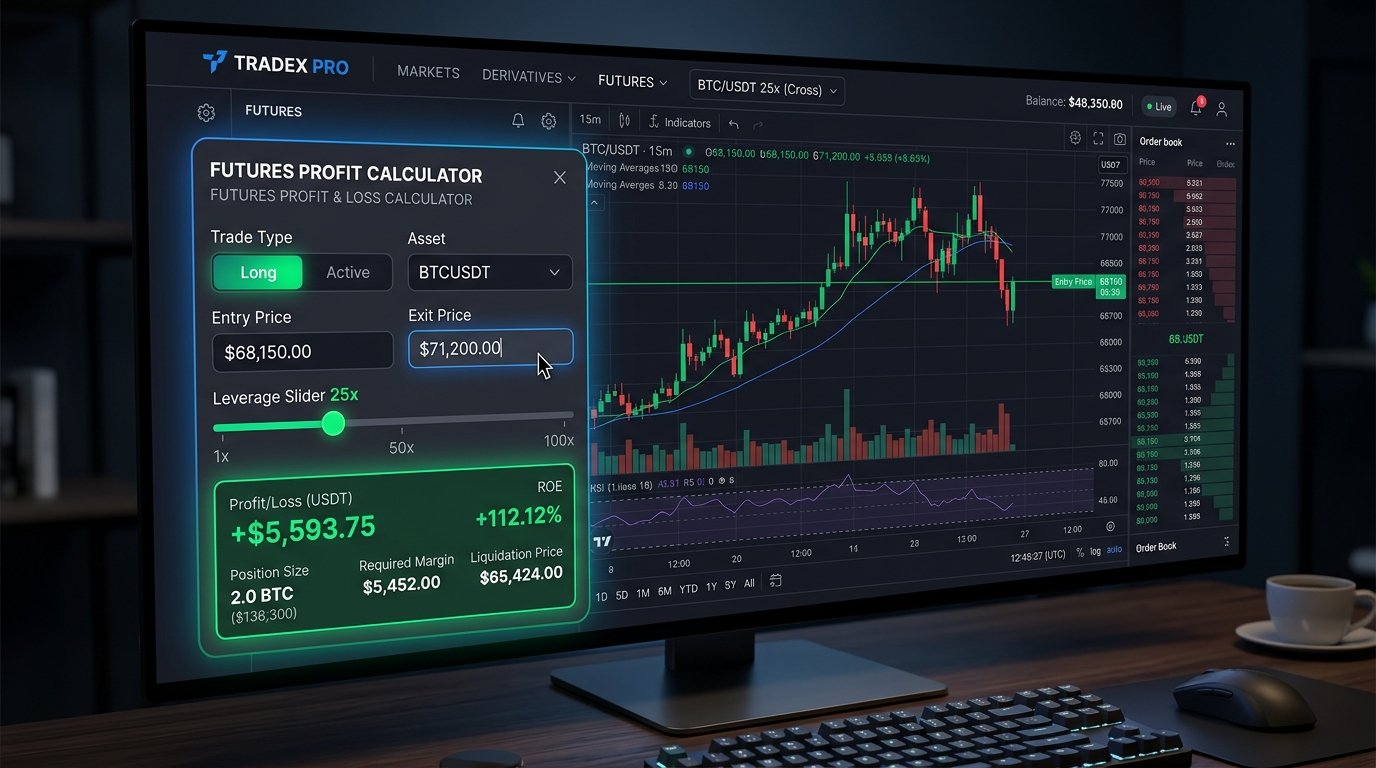
A futures calculator is a specialized tool that instantly computes your potential profit or loss, required margin, liquidation price, risk-reward ratio, and position size — all before you place a single trade. Instead of doing complex arithmetic in your head under pressure, you simply enter your entry price, exit price, leverage, and number of contracts, and the calculator does the heavy work in seconds.
In this ultimate guide, you will learn:
- What a futures calculator is and how it works
- The key formulas every futures trader must understand
- How to calculate profit, loss, margin, and liquidation price step by step
- The difference between crypto futures calculators and traditional futures calculators
- Tips for using a calculator to manage risk effectively
- How top platforms like Binance Futures, TradeZella, and InsiderWeek approach this tool
- A comparison of the best futures calculators available in 2025
Whether you are a complete beginner or an experienced trader looking to sharpen your edge, this guide will walk you through everything you need to know.
Futures Calculator
Calculate P&L, margin, liquidation price & risk-reward for CME futures and crypto perpetual contracts.
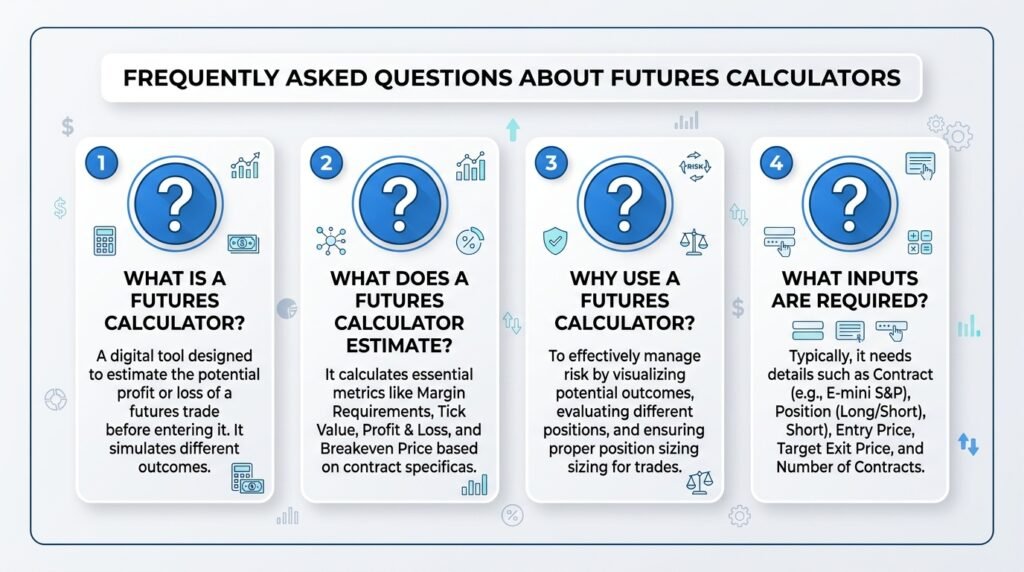
What Is a Futures Calculator?
A futures calculator is a digital tool — available online or embedded within a trading platform — that automates the financial math behind a futures trade. It takes your trade inputs and produces precise outputs so you know exactly what you stand to gain or lose.
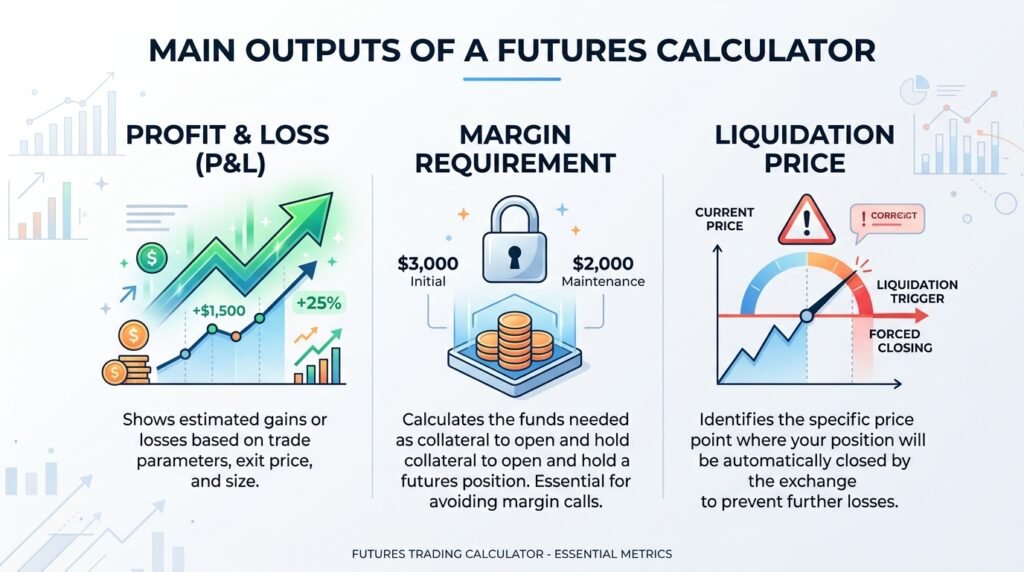
At its core, a futures calculator handles three fundamental calculations:
- Profit & Loss (P&L) — How much money will you make or lose if price moves from Point A to Point B?
- Margin Requirement — How much capital do you need in your account to open and maintain this position?
- Liquidation Price — At what price level will your broker forcibly close your position to prevent further losses?
Some advanced calculators also include:
- Position size recommendation based on account risk percentage
- Risk-reward ratio analysis
- Return on equity (ROE) calculation
- Funding rate impact (for perpetual crypto futures)
How Futures Contracts Work (Quick Refresher)
Before diving into the calculator mechanics, let us briefly recap what a futures contract actually is.
A futures contract is a legally binding agreement to buy or sell a specific asset at a predetermined price on a set expiration date. These contracts are traded on regulated exchanges like the CME Group (Chicago Mercantile Exchange), which sets standardized specifications including contract size, tick value, and margin requirements.
Key futures terminology you will encounter in any calculator:
| Term | Definition |
|---|---|
| Entry Price | The price at which you open your position |
| Exit Price | The price at which you close your position |
| Contract Size | The quantity of the underlying asset per contract |
| Tick Size | The minimum price movement of the contract |
| Tick Value | The dollar value of one tick movement |
| Leverage | The multiplier applied to your margin capital |
| Initial Margin | Capital required to open a position |
| Maintenance Margin | Minimum capital to hold a position open |
| Mark Price | The fair value price used to calculate unrealized P&L |
| Liquidation Price | The price at which your position is forcibly closed |
Understanding these terms is the foundation for using any futures calculator correctly.
The Core Formulas Inside Every Futures Calculator
Every futures calculator — whether for CME futures or crypto futures — is built on a set of standard financial formulas. Let us break them down clearly.
1. Futures Profit & Loss Formula
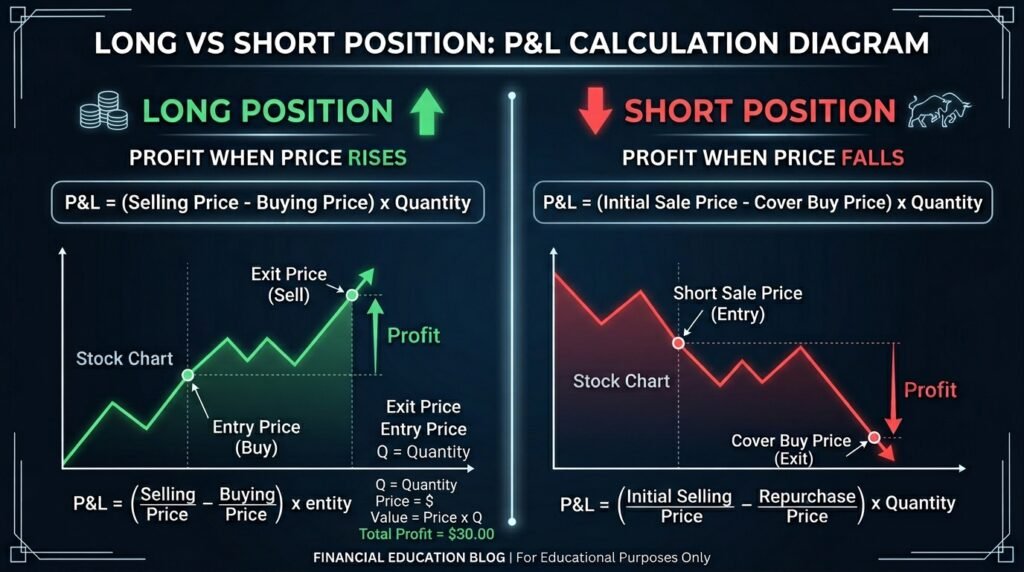
For a long position (you expect price to rise):
P&L = (Exit Price – Entry Price) × Contract Size × Number of Contracts
For a short position (you expect price to fall):
P&L = (Entry Price – Exit Price) × Contract Size × Number of Contracts
Example (ES — E-mini S&P 500):
- Entry Price: 5,200
- Exit Price: 5,250
- Tick value: $12.50 per tick (1 tick = 0.25 points)
- Points moved: 50 points = 200 ticks
- P&L = 200 ticks × $12.50 = $2,500 per contract
2. Futures Margin Requirement Formula
Initial Margin = Contract Value × Margin Rate
Contract Value = Entry Price × Contract Multiplier
Example (Gold Futures — GC):
- Entry Price: $2,350 per oz
- Contract Size: 100 troy oz
- Contract Value: $2,350 × 100 = $235,000
- Initial Margin Rate (approx.): ~2.5%
- Initial Margin ≈ $5,875
Most brokers publish their margin tables. For crypto futures on exchanges like Binance, the margin rate is determined by your chosen leverage level.
3. Leverage & Position Size Formula
Position Size = Margin × Leverage
Leverage = Position Size ÷ Margin
Example (Crypto Futures — BTC Perpetual):
- Margin (collateral): $1,000
- Leverage: 10x
- Position Size = $1,000 × 10 = $10,000
This means you are controlling a $10,000 position with only $1,000 of your own capital.
4. Liquidation Price Formula
For a long position:
Liquidation Price = Entry Price × (1 – (1 / Leverage) + Maintenance Margin Rate)
For a short position:
Liquidation Price = Entry Price × (1 + (1 / Leverage) – Maintenance Margin Rate)
This is one of the most critical calculations in crypto futures trading because reaching the liquidation price means total loss of your margin.
Step-by-Step: How to Use a Futures Calculator
Using a futures calculator is straightforward once you understand what each input means. Here is a step-by-step walkthrough.
Step 1: Select Your Futures Contract
Choose the market you are trading. This matters because every contract has a unique tick value and contract multiplier. For example:
- ES (E-mini S&P 500): $50 per point, tick value $12.50
- NQ (E-mini Nasdaq 100): $20 per point, tick value $5.00
- GC (Gold): $100 per troy oz, 100 oz per contract
- CL (Crude Oil WTI): $1,000 per $1 move, 1,000 barrels
- BTC (CME Bitcoin Futures): 5 BTC per contract
If you are using a crypto platform calculator (Binance, Bitget), you simply select the trading pair such as BTC/USDT or ETH/USDT.
Step 2: Select Direction — Long or Short
Specify whether you are buying (long) or selling (short). This flips the profit/loss calculation.
Step 3: Enter Your Entry Price
Input the price at which you plan to enter the trade. For open trades, use your actual fill price.
Step 4: Enter Your Exit Price or Take Profit / Stop Loss
Most calculators ask for either:
- A specific exit price (to calculate exact P&L), or
- A take profit AND stop loss level (to calculate risk-reward ratio)
Step 5: Set Your Leverage (Crypto) or Number of Contracts (CME)
- For CME-style calculators (InsiderWeek, TradeZella): Enter the number of contracts
- For crypto futures calculators (Binance, Bitget): Set your leverage multiplier
Step 6: Enter Commission / Fees (Optional)
Professional calculators like TradeZella include a commission field so your net P&L accounts for round-trip trading costs. This is particularly important for day traders who make dozens of trades per day.
Step 7: Read Your Results
The calculator instantly returns:
- Gross P&L — profit or loss before fees
- Net P&L — profit or loss after fees and commission
- Required Margin — capital needed to open the trade
- Liquidation Price — the price that would wipe your margin
Risk-Reward Ratio — the ratio of potential profit to potential loss.
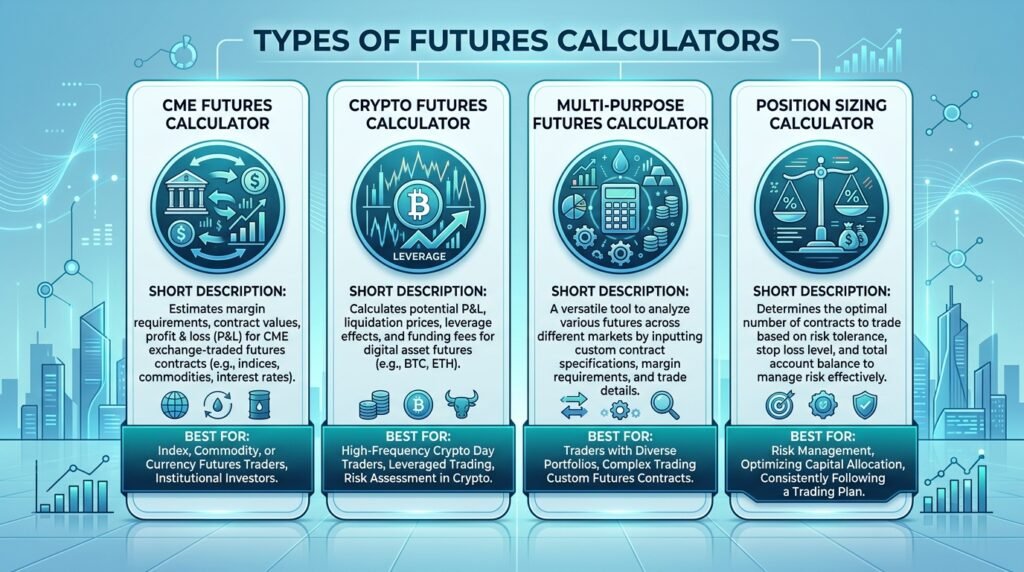
Types of Futures Calculators
Not all futures calculators are the same. Here is a breakdown of the main types you will encounter.
1. CME / Traditional Futures Calculator
Designed for professional traders on regulated US futures exchanges. These calculators include pre-loaded contract specifications for indices (ES, NQ, YM, RTY), metals (GC, SI), energies (CL, NG), grains (ZC, ZS, ZW), and currencies (6E, 6J, 6B).
Best tools: InsiderWeek Futures Calculator, TradeZella Futures Calculator
2. Crypto Futures Calculator (Perpetual Contracts)
Designed for traders on exchanges like Binance, Bitget, Bybit, and OKX. These calculators focus on perpetual contracts with variable leverage (up to 125x on some platforms) and include funding rate considerations.
Best tools: Binance Futures Calculator, Bitget Futures Calculator
3. Multi-Purpose Profit Calculator
Broad calculators that cover forex, CFDs, stocks, and futures in a single tool.
Best tool: Investing.com Profit Calculator
4. Position Size / Risk Management Calculator
Focuses specifically on how many contracts to trade based on your account size and acceptable risk percentage. These are favored by professional risk managers.
Best tool: TradeZella Position Size Calculator, DappGrid Leverage Calculator
Futures Calculator in Action: Real-World Examples
Example 1: E-mini S&P 500 (ES) Trade Calculation
Scenario: You are going long on ES futures.
- Entry Price: 5,180
- Exit Price (Take Profit): 5,230
- Stop Loss: 5,160
- Number of Contracts: 2
- Commission: $4.80 per round trip
Calculation:
- Points gained: 5,230 – 5,180 = 50 points
- Dollar value per point: $50
- Gross P&L = 50 × $50 × 2 = $5,000
- Commission: $4.80 × 2 = $9.60
- Net P&L = $5,000 – $9.60 = $4,990.40
- Points at risk: 5,180 – 5,160 = 20 points = $2,000 loss if stop hit
- Risk-Reward Ratio: 2.5:1
Example 2: Bitcoin Perpetual Futures (BTC/USDT) — Crypto Exchange
Scenario: You are going long on BTC/USDT perpetual with 10x leverage.
- Entry Price: $65,000
- Exit Price: $68,000
- Margin (collateral): $500 USDT
- Leverage: 10x
- Position Size: $500 × 10 = $5,000
Calculation:
- Price change: $68,000 – $65,000 = $3,000
- Return % = ($3,000 / $65,000) × 100 = 4.61%
- P&L = 4.61% × $5,000 = $230.77
- ROE = $230.77 / $500 = 46.15%
Liquidation Estimate:
- Liquidation Price ≈ $65,000 × (1 – 1/10) = $58,500
This means if BTC drops to ~$58,500, your entire $500 margin is wiped out.
Example 3: Crude Oil Futures (CL) — Short Trade
Scenario: You are shorting Crude Oil due to bearish sentiment.
- Entry Price: $78.50
- Exit Price (Target): $76.00
- Contracts: 1
- CL Contract Size: 1,000 barrels
Calculation:
- Price move: $78.50 – $76.00 = $2.50
- P&L = $2.50 × 1,000 × 1 = $2,500
Top Futures Calculators Compared: Competitor Analysis
After analyzing the top-ranking competitors for “futures calculator,” here is how each platform stacks up.
1. InsiderWeek Futures Calculator ⭐ Best for CME Futures
InsiderWeek offers the most comprehensive traditional futures calculator for US markets. It supports over 80 futures contracts across indices, energies, metals, grains, currencies, and softs. Traders can calculate long/short positions, input take profit and stop loss levels, set account size, and get risk-reward ratios with risk profiles ranging from 0.5% to 10%.
Strengths: Wide contract selection (80+), professional-grade, risk profile calculator, PDF download
Weakness: No crypto perpetual contract support
Word count on page: ~2,100 words of supporting content
Best for: Professional traders in US futures markets
2. TradeZella Futures Calculator ⭐ Best for Position Sizing
TradeZella targets active day traders with a dual-mode calculator — P&L mode and Position Size mode. It covers 28+ contracts and integrates with their broader trading journal platform. The position sizing tool is especially powerful, letting traders set an account size and risk percentage to determine the exact number of contracts to trade.
Strengths: Dual mode (P&L + Position Size), commission included, clean UX, journal integration
Weakness: Fewer contracts than InsiderWeek, requires sign-up for journal features
Word count on page: ~2,500 words of supporting content
Best for: Day traders, prop firm traders, risk-conscious traders
3. Binance Futures Calculator ⭐ Best for Crypto Perpetuals
Binance’s built-in calculator is the gold standard for crypto perpetual futures. It covers PnL calculation, margin requirement, and liquidation price for all Binance Futures pairs. Because it is embedded directly within the trading interface, it uses live market data.
Strengths: Live data, built into the exchange, supports all BN pairs, simple UX
Weakness: Only works for Binance products, no CME coverage
Best for: Crypto futures traders on Binance
4. Bitget Futures Calculator ⭐ Best for Crypto with Fee Transparency
Bitget’s profit calculator is clean and fast. It focuses on crypto futures with clear input fields for entry/exit price, margin, and leverage. It also displays open/close fee estimates, which makes it useful for understanding total trading costs.
Strengths: Fast, includes fee breakdown, supports multiple crypto pairs
Weakness: Limited to Bitget products, no traditional futures
Best for: Crypto traders on Bitget exchange
5. DappGrid Binance Futures Calculator ⭐ Best Educational Resource
DappGrid hosts a third-party Binance futures calculator combined with detailed educational content explaining how to use it step by step. It is the most content-rich resource among the competitors, with detailed guides on margin types, PnL formulas, and liquidation mechanics.
Strengths: Educational content, step-by-step tutorials, accessible to beginners
Weakness: Third-party tool (not exchange-native), limited contract coverage
Word count on page: ~1,800 words
Best for: Beginners learning crypto futures
6. Investing.com Profit Calculator ⭐ Best for Multi-Asset Trading
Investing.com’s profit calculator is the broadest in scope, covering forex, CFDs, commodities, and indices in a single interface. While it is not purely a futures calculator, its brand authority and massive traffic make it a dominant player.
Strengths: Multi-asset, trusted brand (Alexa top 200 financial sites), supports forex pairs
Weakness: Less specialized for futures-specific calculations
Best for: Multi-asset traders, forex traders who occasionally trade futures
7. FutureContractCalculator.com ⭐ Best Simple Standalone Tool
This is a lean, ad-supported standalone tool focused purely on futures contract calculations. It is straightforward with no bloat — ideal for traders who just want a fast answer without distractions.
Strengths: Fast, no sign-up required, focused
Weakness: Minimal educational content, sparse UI
Best for: Traders who want a quick no-frills calculation.
Using a Futures Calculator for Risk Management
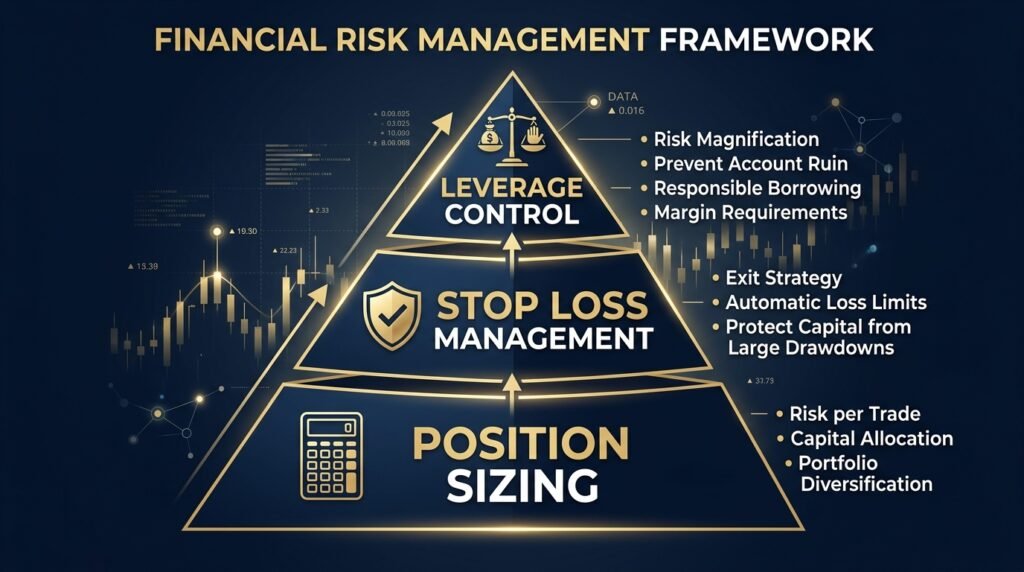
The most underutilized function of a futures calculator is risk management — not just profit projection. Here is how professional traders use it:
The 1-2% Rule
Most professional traders risk no more than 1-2% of their account per trade. A position sizing calculator lets you reverse-engineer the correct number of contracts.
Formula:
Max Risk Amount = Account Size × Risk %
Contracts = Max Risk Amount ÷ (Stop Loss Distance × Tick Value)
Example:
- Account Size: $50,000
- Risk per trade: 1% = $500
- ES stop loss: 10 points = $500 per contract
- Contracts = $500 ÷ $500 = 1 contract
This keeps a single losing trade from significantly damaging your account.
Understanding Leverage Risk
Leverage magnifies both profits and losses proportionally. At 10x leverage, a 10% move in the underlying asset wipes your entire margin. At 50x leverage, only a 2% adverse move is required to liquidate your position.
The futures calculator makes this visible — helping traders choose sensible leverage levels based on their stop loss distance and volatility expectations.
Calculating Risk-Reward Before Every Trade
Entering a trade without knowing your risk-reward ratio is gambling. A proper futures calculator shows you:
- Maximum possible profit (to take profit level)
- Maximum possible loss (to stop loss level)
- Risk-reward ratio expressed as X:1
Professional standard: Most traders require a minimum 2:1 risk-reward ratio before entering a trade.
Common Mistakes to Avoid When Using a Futures Calculator
Even with a calculator in hand, traders make preventable errors. Here are the most common:
1. Forgetting Tick Value Differences
ES and MES (Micro E-mini) have the same price but very different tick values ($12.50 vs $1.25). Always confirm the correct contract multiplier.
2. Ignoring Commissions on High-Frequency Trades
A $4.80 round-trip commission sounds trivial, but for a trader making 20 trades per day, that is $96/day or ~$24,000 per year. Include commissions in every calculation.
3. Confusing Cross-Margin vs Isolated Margin (Crypto)
Cross-margin mode uses your entire wallet balance as collateral, dramatically changing the liquidation price. Most beginners accidentally leave cross-margin on, which means a bad trade can eat funds from other positions.
4. Not Accounting for Overnight Funding Rates
Crypto perpetual futures charge a funding rate every 8 hours. On highly leveraged positions held overnight, these fees can significantly erode profits. A complete calculator should include funding rate estimates.
5. Over-Leveraging Due to “Small Distance to Stop”
Traders sometimes increase position size because their stop loss is “only 5 ticks away.” This ignores the compounding risk from wider market moves post-entry. Use position sizing mode to stay disciplined.
Futures Calculator FAQs
Yes, for the inputs you provide. The calculator is mathematically precise. The uncertainty comes from market slippage, funding rates, and exchange-specific fees — factors you need to estimate yourself.
No. Most standalone futures calculators (TradeZella, InsiderWeek, DappGrid, FutureContractCalculator.com) are completely free and require no sign-up.
A futures calculator computes linear profit/loss based on price movement. An options calculator (like Black-Scholes) also accounts for time decay, implied volatility, and the nonlinear delta of options contracts. They are fundamentally different tools.
Not directly — CME Bitcoin contracts (BTC, MBT) have different specifications than exchange perpetuals. CME BTC futures have a fixed contract size of 5 BTC, while Binance perpetuals are sized differently. Use a CME-specific calculator like TradeZella for these contracts.
There is no universal answer, but most professional traders use effective leverage of 2x-5x even when higher leverage is available. The goal is to size positions so that a reasonable stop loss distance represents only 1-2% of account value.
First convert points to dollars by multiplying by the point value. For ES: 10 points × $50/point = $500. For NQ: 10 points × $20/point = $200.
How to Choose the Right Futures Calculator for You
Here is a quick decision guide:
| Your Trading Style | Best Calculator |
|---|---|
| CME Futures (ES, NQ, CL, GC) | InsiderWeek or TradeZella |
| Crypto Perpetuals on Binance | Binance Built-in Calculator |
| Crypto Perpetuals on Bitget | Bitget Calculator |
| Position sizing & risk first | TradeZella Position Size Mode |
| Beginners learning basics | DappGrid or FutureContractCalculator.com |
| Multi-asset (Forex + Futures) | Investing.com Profit Calculator |
| Prop firm traders | TradeZella (Prop Firm Sync feature) |
Advanced Topics: Beyond Basic P&L Calculation
Funding Rates in Crypto Perpetual Futures
Unlike CME futures which expire quarterly, crypto perpetual futures have no expiry date. Instead, they use a funding rate mechanism — typically charged every 8 hours — that keeps the perpetual price anchored near the spot price.
Funding P&L = Position Size × Funding Rate × Number of Funding Periods
When the market is bullish, longs pay funding to shorts. When bearish, shorts pay longs. This can either erode profits or add to them over time.
Rollover Costs for CME Futures
CME futures contracts expire quarterly (March, June, September, December). Traders who want to maintain exposure must “roll” their position to the next contract. This involves closing the expiring contract and opening the new one — incurring spread and commission costs.
Mark-to-Market Daily Settlement
Unlike stocks, CME futures are marked to market daily. This means your account is credited or debited each day based on the closing settlement price, regardless of whether you have closed your trade. This is why futures traders must maintain sufficient capital to cover daily losses even on winning longer-term positions.
Conclusion: Make Every Trade Count with a Futures Calculator
The futures market offers extraordinary opportunities — but only for those who approach it with precision. A futures calculator removes guesswork, eliminates arithmetic errors, and gives you the clarity to make disciplined decisions based on data rather than emotion.
Before every trade, ask yourself:
- What is my maximum dollar risk?
- Where is my liquidation price?
- Does this trade meet my minimum risk-reward requirement?
- Am I sized correctly for my account?
A futures calculator answers all four questions in seconds.
Whether you choose the comprehensive contract library of InsiderWeek, the risk-first approach of TradeZella, the live data of the Binance Calculator, or the educational content of DappGrid — the right futures calculator is the one you actually use consistently.
Start calculating before you trade. Your account balance will thank you. Check Live Rates of Different Coins.