
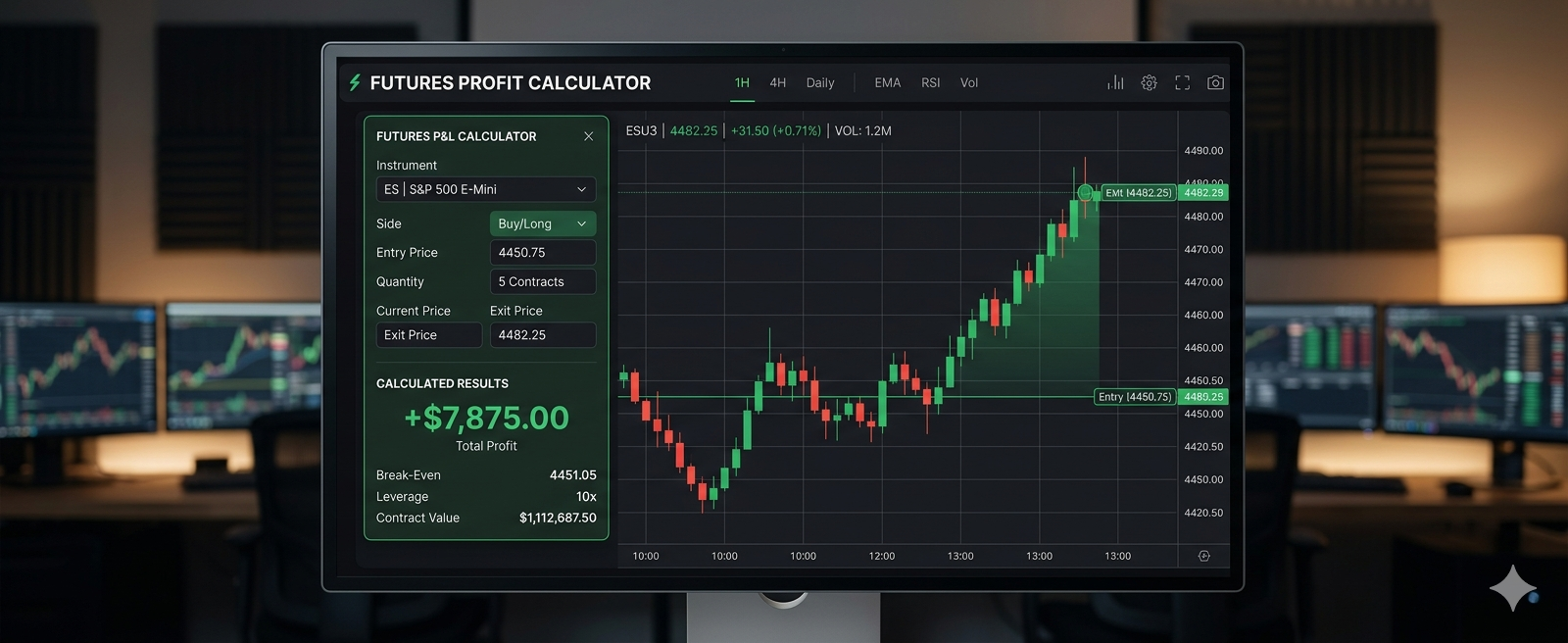
Every futures trader faces the same critical question before entering a trade: How much can I make — and how much can I lose? The answer lives inside one essential tool: the futures profit calculator.
Whether you’re trading E-mini S&P 500 contracts, crude oil futures, gold, or Bitcoin derivatives, calculating your potential profit and loss (PnL) before you click ‘buy’ or ‘sell’ is not optional — it’s the foundation of disciplined risk management.
In this complete guide, you’ll learn exactly how futures PnL is calculated, what inputs the calculator needs, how leverage affects your results, and how to apply this knowledge to every trade you place. By the end, you’ll never enter a futures trade without knowing your exact risk and reward.
What Is a Futures Profit Calculator?
A futures profit calculator is a tool that estimates the profit or loss on a futures trade based on four key inputs: your entry price, exit price, the number of contracts traded, and the contract’s specific tick size and tick value.
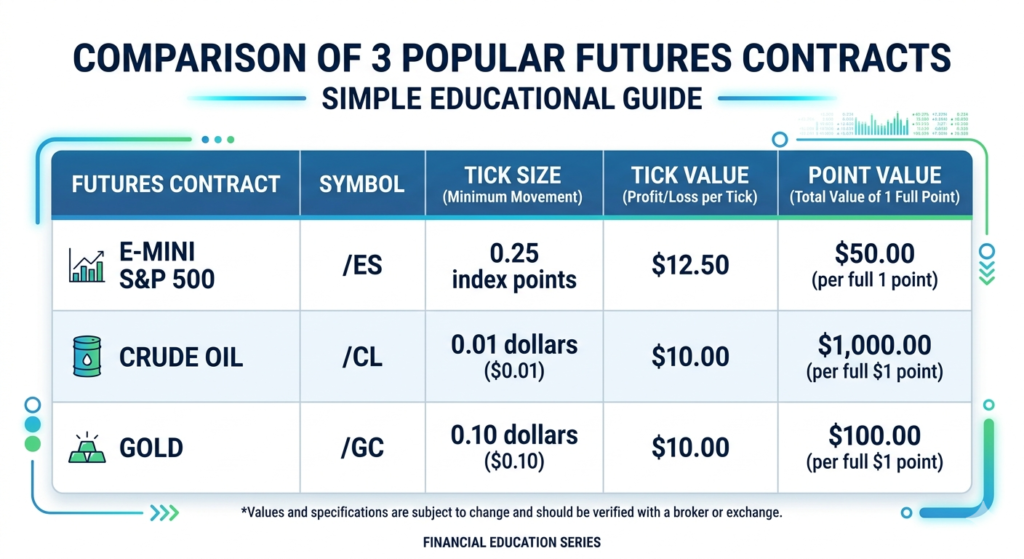
Unlike stocks, where profit is simply (exit price − entry price) × shares, futures contracts have standardized specifications that vary by market. Each futures contract has a defined point value — the dollar amount gained or lost for every one-point move in the underlying asset.
For example, the E-mini S&P 500 (ES) futures contract has a point value of $50. That means a 10-point move translates to a $500 profit or loss per contract. Without knowing this, it’s impossible to accurately size a position or assess risk.
Why Traders Use a Futures Profit Calculator
- To know exact dollar risk before entering a trade.
- To set realistic take-profit and stop-loss levels.
- To calculate the right position size for their account.
- To compare risk-reward ratios across different setups.
- To practice trade planning without real money on the line.
The Futures PnL Formula Explained
The core formula behind every futures profit calculator is straightforward:
Profit / Loss = (Exit Price − Entry Price) × Point Value × Number of Contracts
For short trades, the formula flips: profit comes from price falling below your entry. The calculator handles this automatically when you select ‘Long’ or ‘Short’ as your direction.
📊 Futures Profit & Risk Calculator
Precise PnL · Tick-to-dollar · Risk/Reward ratio · Position sizing clarity
Breaking Down the Formula: Key Terms
- Entry Price: The price at which you open your futures position
- Exit Price: The price at which you close the trade (your take-profit or stop-loss level)
- Point Value: The dollar value of a one-point move in the contract (varies by market)
- Number of Contracts: How many contracts you’re trading simultaneously
- Tick Size: The minimum price increment the contract can move
- Tick Value: The dollar value of one tick movement
Long Trade Example — E-mini S&P 500 (ES)
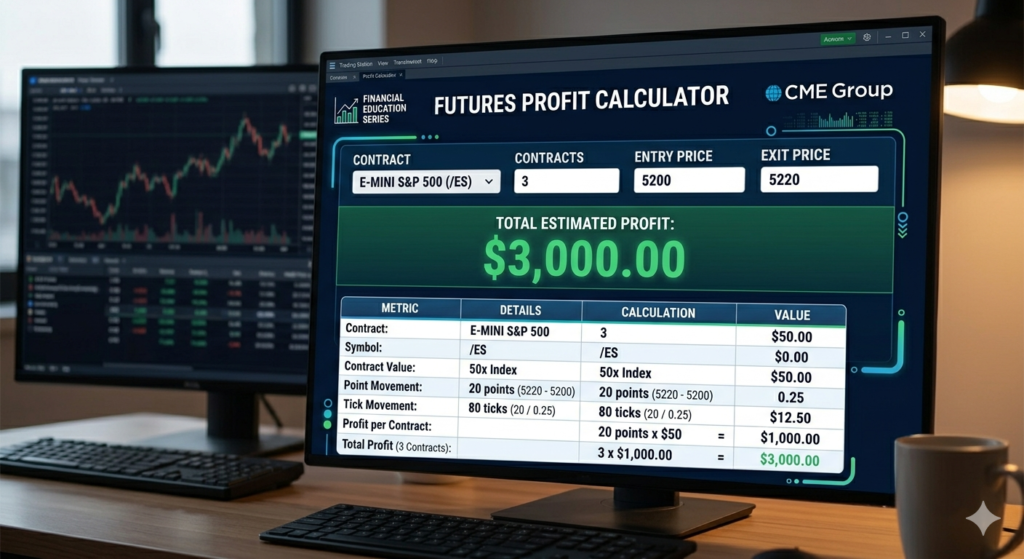
Let’s say you go long on the ES futures contract at 5,200 with a target of 5,220 and a stop at 5,190. Here’s how the math works:
•Entry Price: 5,200
•Take-Profit Exit: 5,220 → Move = +20 points → Profit = 20 × $50 = $1,000 per contract
•Stop-Loss Exit: 5,190 → Move = −10 points → Loss = 10 × $50 = $500 per contract
•Risk/Reward Ratio: 1:2 (risking $500 to make $1,000)
If you trade 3 contracts, your profit target grows to $3,000 and your maximum risk is $1,500. A futures profit calculator shows you all of this in seconds, without mental math errors.
How Leverage Changes Your PnL Calculation
Futures markets are leveraged by design. Unlike buying a stock outright, you only deposit a fraction of the contract’s full value — this deposit is called the margin requirement. Leverage amplifies both gains and losses, which is why understanding PnL before you trade is critical.
For example, the E-mini S&P 500 futures contract controls $50 × the index level. At an index level of 5,200, one ES contract controls $260,000 in notional value. Yet the intraday margin to trade it may be as low as $1,500 to $2,000 — meaning a single tick move of $12.50 can represent a significant percentage of your margin deposit.
Leverage Formula Leverage Ratio = Contract Notional Value ÷ Margin Requirement
This is why professional traders always calculate their position size in relation to their total account equity — not just their margin. Risking 1–2% of account equity per trade is a widely accepted principle among institutional traders.
Want to go deeper on leverage? The
CME Group’s official margin documentation provides real-time
margin requirements for all CME-listed contracts.
Futures Profit Calculator: Step-by-Step How to Use It
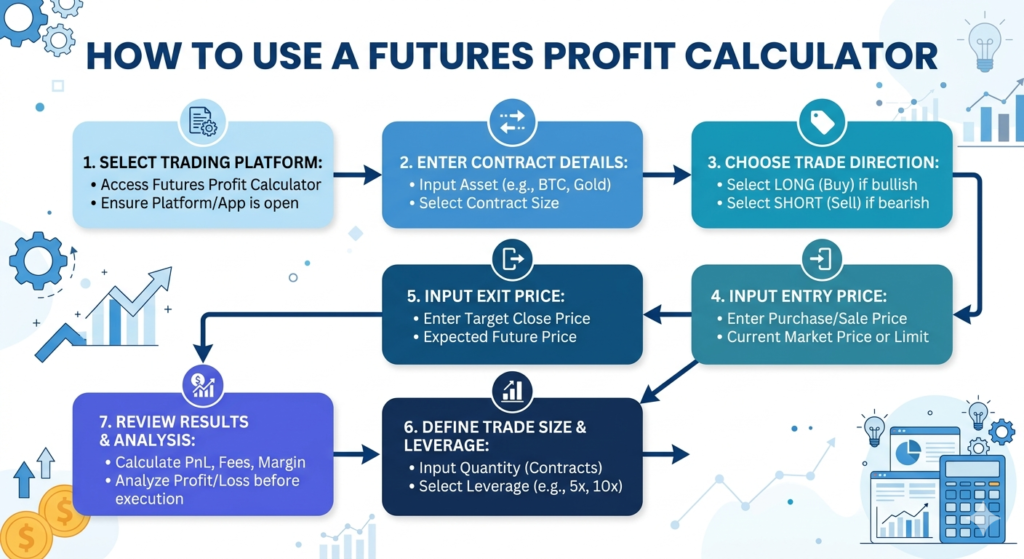
Using a futures profit calculator is simple. Here’s a universal process that applies to any calculator — including the one on our site:
- Select your futures contract (e.g., ES, NQ, CL, GC, BTC)
- Choose your direction: Long (buy) or Short (sell)
- Enter your entry price
- Enter your target exit price (take-profit)
- Enter your stop-loss price (risk exit)
- Enter the number of contracts you plan to trade
- Read your results: potential profit, potential loss, and risk/reward ratio
The calculator then tells you your potential profit in dollars, your potential loss in dollars, the number of ticks and points your target represents, and your risk-to-reward ratio. Only enter trades where the math makes sense for your trading plan.
Understanding Ticks vs. Points in Futures Trading
One of the most confusing aspects for new futures traders is the difference between ticks and points —
and most profit calculators display both. Here’s a clear breakdown:
- A Point is a one-unit move in the futures contract price
- A Tick is the minimum price increment the contract can move (smaller than a point)
- Tick Value is the dollar value of one tick movement
Short Selling Futures: How the Calculator Works in Reverse
Futures markets are two-sided — you can profit from falling prices just as easily as rising prices. When you go short’, you’re selling a contract you don’t own, with the intention of buying it back at a lower price.
The profit formula for a short trade is: Profit / Loss = (Entry Price − Exit Price) × Point Value × Number
Example: You short crude oil (CL) at $82.00 per barrel. Your take-profit is $79.50 and your stop is $83.00.
With 1 contract (point value $1,000):
- Potential Profit: (82.00 − 79.50) × $1,000 = $2,500
- Potential Loss: (83.00 − 82.00) × $1,000 = $1,000
- Risk/Reward Ratio: 1:2.5 — an excellent setup
Futures PnL Calculator vs. Manual Calculation: Which Is Better?
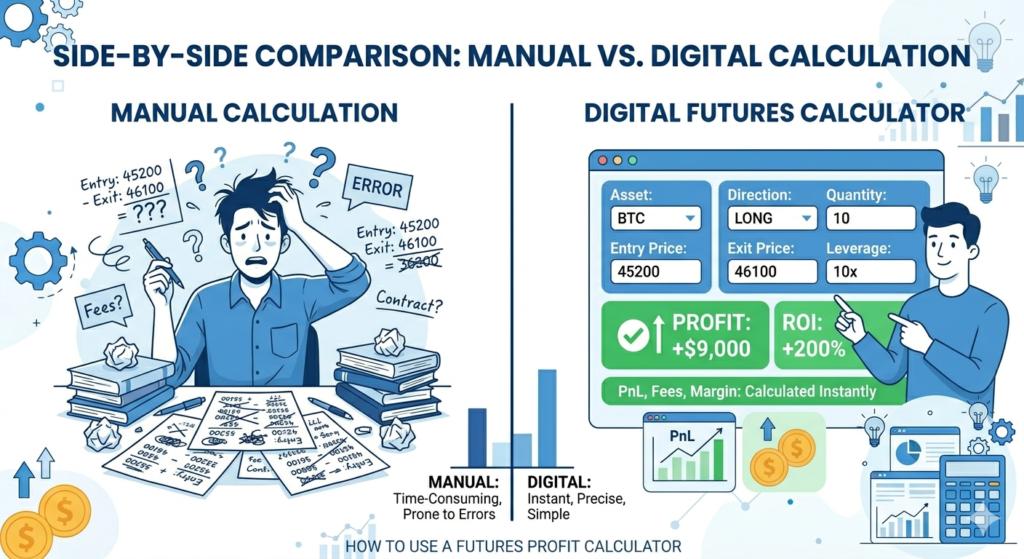
While understanding the formula is essential, manual calculation is slow and error-prone — especially under market pressure. A good futures profit calculator eliminates math errors, instantly shows riskreward ratios, supports dozens of contract types with pre-loaded specifications, and allows you to model multiple scenarios before placing your trade.
The best calculators on the market — including those offered by platforms like InsiderWeek, MetroTrade, and Trademetria — support 50 to 100+futures contracts across equities, commodities, currencies, and crypto. They auto-load tick size and tick value, so you only need to input prices and contract count. For a broader understanding of futures market structure and regulation, visit the Commodity Futures Trading Commission (CFTC) — the U.S. regulatory body overseeing all futures trading.
How to Use a Futures Profit Calculator for Risk Management
Beyond calculating profits, a futures PnL calculator is fundamentally a risk management tool. Here’s how professional traders use it:
1. Position Sizing
Before entering a trade, decide the maximum dollar amount you’re willing to lose. Divide that by the per-contract loss at your stop-loss price to determine how many contracts to trade.
Max Contracts = (Account Risk ÷ Per-Contract Loss at Stop)
2. Validating Risk/Reward Before Every Trade
Most successful futures traders require a minimum 1:2 risk-to-reward ratio. If the calculator shows your setup only offers 1:1, you either adjust your target, tighten your stop, or skip the trade entirely.
3. Scenario Planning
Use the calculator to model multiple exit scenarios: What if I exit at my first target? What if I hold for the full move? What’s my breakeven after commissions? This scenario planning builds mental preparation and eliminates emotional decision-making during the trade.
For educational resources on risk management in futures, the National Futures Association (NFA) offers free guides on responsible trading practices and investor protection.
Crypto Futures Profit Calculator: Bitcoin, Ethereum, and Beyond
Crypto futures have become one of the fastest-growing segments of the futures market. Bitcoin futures (BTC) trade on the CME, and micro Bitcoin futures (MBT) allow smaller position sizes. The profit calculation follows the same formula, but the high volatility of crypto means potential profits — and losses — are amplified.
For example, Bitcoin Micro Futures (MBT) has a contract size of 0.10 BTC. At a BTC price of $80,000, one MBT contract controls $8,000. A 5% move in Bitcoin equals a $400 move per contract — which is significant relative to the margin required.
Always apply the same PnL calculator discipline to crypto futures as you would to equity index futures. Volatility does not eliminate the need for precise risk calculation — it makes it more urgent.
Common Mistakes Traders Make Without a Futures Calculator
Trading too many contracts relative to their account size (over-leveraging)
• Setting stop-losses without knowing the exact dollar risk they represent
• Ignoring the difference between tick value and point value for unfamiliar contracts
• Calculating profit in points without converting to dollars
• Failing to account for commissions and slippage in their PnL estimate
• Entering trades with poor risk/reward ratios because the math looked different in their head
A futures profit calculator eliminates all of these errors. It forces you to think in dollars, not just price levels — which is the mental shift that separates amateur traders from professionals
Futures Calculator vs. Options Calculator: What’s the Difference?
Futures and options calculators both estimate potential PnL, but they work very differently. A futures PnL calculator is linear — every point move produces the same dollar change regardless of time or market conditions. Futures contracts have no time decay.
An options profit calculator, by contrast, must account for delta, theta (time decay), implied volatility, and whether the option is in or out of the money. Futures are simpler and more direct, making the calculator correspondingly straightforward to use.
If you trade futures options (options on futures contracts), you’ll need a more sophisticated calculator that handles the Greeks. For standard futures contracts, the formula-based calculator is all you need.
Frequently Asked Questions About Futures Profit Calculators
Multiply the price difference (exit minus entry for long trades) by the point value and number of contracts. For example: 10 points × $50 point value × 2 contracts = $1,000 profit on an ES trade.
Most professional traders target a minimum of 1:2 — meaning they risk $1 to make $2. Some traders use 1:3 or higher, accepting a lower win rate in exchange for larger average winners relative to losers.
Most free calculators do not automatically include commissions. You should manually subtract broker commissions (typically $0.25 to $3.50 per side per contract) and account for slippage — especially for market orders in fast-moving markets.
Yes, calculators that support international contracts like the DAX futures (Germany), Nikkei 225 (Japan), Hang Seng (Hong Kong), or Brent crude oil will typically display results in the local currency. Verify the contract specifications for the correct point value.
Yes, reputable futures calculators — including those from InsiderWeek, Trademetria, MetroTrade, and Investing.com — are available free of charge. Some premium platforms include advanced scenario analysis as part of a paid trading journal subscription.
Final Thoughts: Make the Calculator Part of Every Trade
A futures profit calculator is not a luxury — it’s a necessity. It transforms abstract price levels into concrete dollar outcomes, forces you to define your risk before you enter, and helps you maintain the discipline that separates profitable traders from the majority who struggle.
Before your next trade, run the numbers. Enter your entry, your target, your stop, and your contract count. If the risk-reward makes sense and the dollar risk fits your account plan, take the trade. If it doesn’t, wait for a better setup.
The calculator doesn’t predict the future. But it ensures that when the market moves, you already know exactly what that means for your account — and you’re prepared for any outcome. Learn Real Rate of Currency.