Staking is one of the simplest ways to earn passive income in crypto. Instead of selling your coins, you lock them up to help secure a proof-of-stake network — and in return, the network pays you rewards. But before you commit, one question matters most: how much will you actually earn?
A crypto staking calculator answers that question in seconds. In this guide, you will learn how staking rewards are calculated, what APY really means, how compounding changes your returns, and how to use a staking calculator to plan realistic passive income for 2026.
What Is a Crypto Staking Calculator?
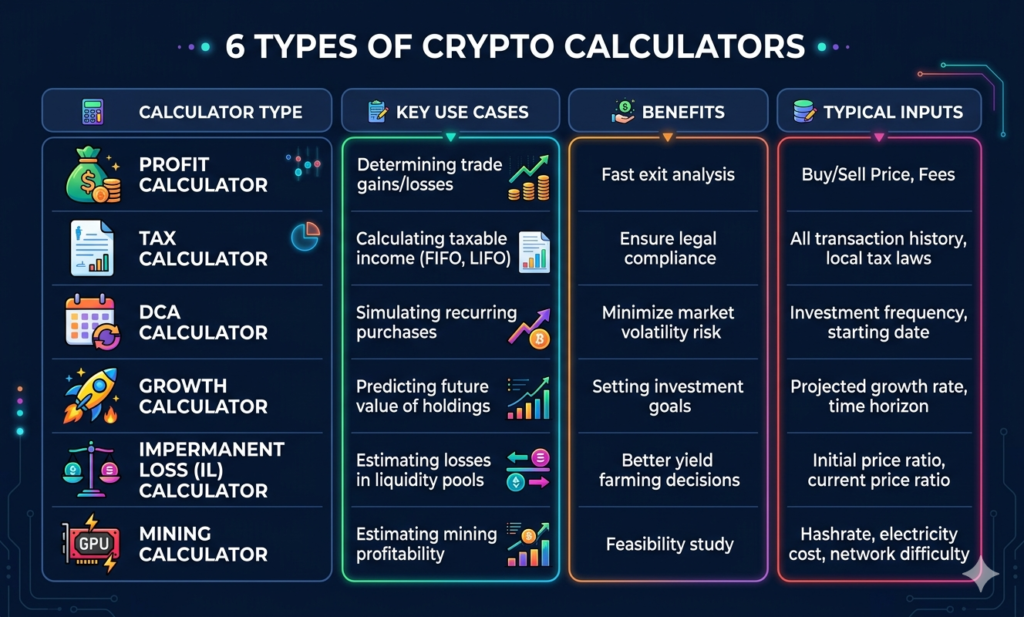
A crypto staking calculator is a tool that estimates the rewards you will earn from staking a given amount of cryptocurrency over a period of time. You typically enter:
- The coin you plan to stake (ETH, SOL, ADA, DOT, ATOM, etc.)
- The amount you will stake
- The annual percentage yield (APY) offered by the network or provider
- The staking duration (days, months, or years)
- Whether rewards are compounded
The calculator then returns your estimated daily, monthly, and yearly earnings, along with your final balance.
APR vs APY: The Difference That Changes Everything
Staking providers often quote either APR (annual percentage rate) or APY (annual percentage yield). They sound similar but are not the same.
- APR is the simple annual interest rate, without compounding.
- APY includes the effect of compounding — when your earned rewards are automatically re-staked to earn more rewards.
For example, 5% APR compounded daily becomes roughly 5.13% APY. Over years, the difference grows. A good staking calculator lets you toggle compounding on or off so you can see both numbers.
The Core Staking Reward Formula
At its simplest, staking rewards are calculated as:
Rewards = Staked Amount × (APY ÷ 100) × (Days ÷ 365)
For compounding, the formula becomes:
Final Balance = Principal × (1 + (APY ÷ Compounding Periods)) ^ (Compounding Periods × Years)
Example: you stake 10,000 ADA at 4.5% APY for one year.
- Simple interest: 10,000 × 4.5% = 450 ADA in a year
- Daily compounding: slightly more — about 460 ADA
These formulas are exactly what a staking calculator automates for you.
Real-World Example: Staking Ethereum (ETH)
Suppose you hold 5 ETH and stake it through a liquid staking provider at 3.8% APY, compounded monthly.
- Principal: 5 ETH
- APY: 3.8%
- Year 1 rewards: ~0.19 ETH
- After 5 years (compounded): ~5.98 ETH
At an ETH price of $3,500, that 5-year reward of ~0.98 ETH is worth about $3,430 — purely from holding and staking, before any price appreciation.
Staking APY Comparison Across Major Networks (2026)
| Network | Typical APY | Lock-up |
|---|---|---|
| Ethereum (ETH) | 3–5% | Variable |
| Solana (SOL) | 6–8% | None / flexible |
| Cardano (ADA) | 3–5% | None / flexible |
| Polkadot (DOT) | 10–14% | 28-day unbonding |
| Cosmos (ATOM) | 10–15% | 21-day unbonding |
| Avalanche (AVAX) | 5–9% | Variable |
Note that APYs change constantly based on network participation and token inflation. Always confirm the live rate before staking.
Key Risks to Understand Before Staking
Staking is not risk-free. Here is what every staker should know:
- Slashing — validators who misbehave can lose a portion of their staked funds.
- Lock-up periods — some networks require an unbonding period during which you cannot move your coins.
- Price volatility — your rewards may rise in coin terms, but if the coin's price drops, your fiat value falls.
- Counterparty risk — when using a centralized exchange or liquid staking provider, you are trusting that platform.

How to Use a Staking Calculator Step by Step
- Choose your coin and confirm its current APY.
- Enter the amount you plan to stake.
- Set the staking period — a month, a year, or longer.
- Select compounding frequency (daily, weekly, monthly, or none).
- Review the projected rewards and final balance.
Running several scenarios — different amounts, different APYs, different time horizons — helps you set realistic expectations before you lock anything up.
Frequently Asked Questions
Is staking profitable?+
Staking can generate consistent passive income, but profitability depends on the coin's APY, the amount staked, and the coin's price movement. Use a staking calculator to model your specific scenario.
Can I lose money staking?+
Yes. If the underlying coin's price drops, the fiat value of your holdings can fall. Slashing events and platform failures are additional risks.
What is the best coin to stake in 2026?+
There is no single best coin. Ethereum, Solana, and Cardano offer flexibility, while Polkadot and Cosmos offer higher APYs with longer unbonding periods. Diversification is key.
Conclusion
A crypto staking calculator turns a vague promise like "earn 5% APY" into a concrete number you can plan around. By understanding APR vs APY, compounding, and the risks involved, you can stake with confidence and let your idle crypto work for you.
Run the numbers before you commit — your future self will thank you.