
Whether you bought Bitcoin at $60,000 and are wondering if you’re in profit, or you’re planning a new altcoin trade and want to see the numbers before you commit — a crypto profit calculator is the fastest, most accurate way to know exactly where you stand.
In this complete guide, we’ll walk you through everything: how crypto profit calculators work, the exact formulas behind them, step-by-step examples, how fees affect your returns, and why understanding your gains matters for taxes in 2026.
What Is a Crypto Profit Calculator?
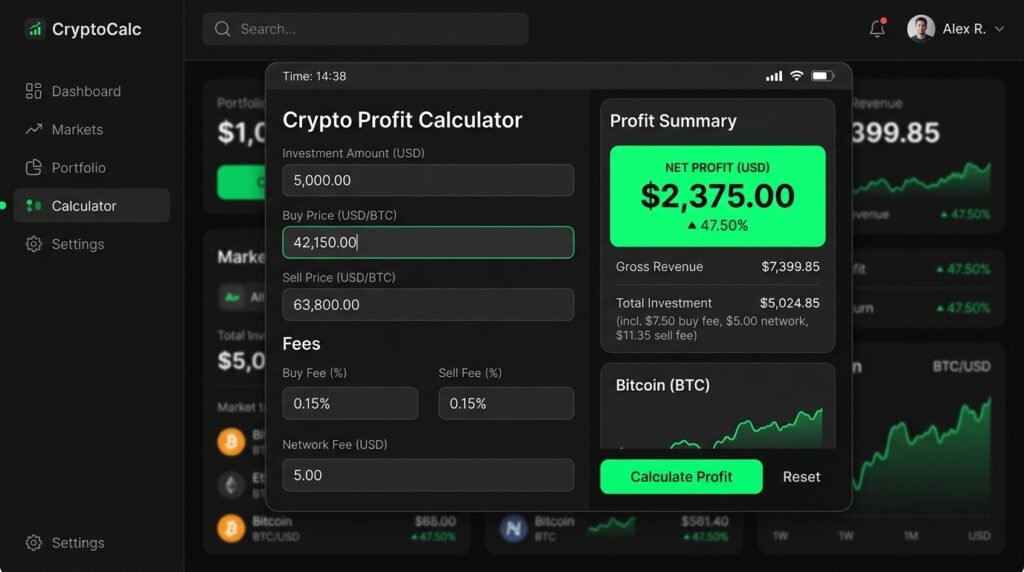
A crypto profit calculator is a digital tool that computes the profit or loss from a cryptocurrency trade based on a few simple inputs: your investment amount, the price you bought at, the price you sold (or plan to sell) at, and any trading fees involved.
Instead of doing manual math — which is error-prone, especially when dealing with volatile assets like Bitcoin or Ethereum — a crypto profit calculator gives you an instant, accurate breakdown of:
- Total profit or loss in dollar terms
- Percentage return on your investment
- Net amount after fees
- Return on Investment (ROI)
These tools are used by beginner investors checking whether a coin is worth buying, seasoned traders managing position sizing, and portfolio managers calculating tax liabilities at year-end.
The best part? You don’t need any financial background to use one. You only need four numbers: investment amount, buy price, sell price, and fees.
Why You Need One (And Can’t Just Guess)
Crypto markets move fast. Bitcoin can swing 10% in a single day. Altcoins can double — or crash — in hours. Guessing whether you’re profitable is not a strategy.
Here’s why a dedicated calculator matters:
Fees Eat Into Profits More Than You Realize
Most exchanges charge between 0.1% and 1% per trade. On a $10,000 trade, that’s $10–$100 in fees, each way. On multiple trades per month, these costs compound quickly. A calculator shows you the true net profit after fees so you’re never caught off guard.
Percentage Gains Can Be Misleading
A 50% gain sounds great — but if you only invested $100, that’s $50. A calculator helps you frame gains in real dollar terms alongside percentages.
Tax Reporting Requires Exact Numbers
In the US, UK, Australia, and most other countries, crypto gains are taxable. You need precise profit figures — not estimates — to file correctly. A calculator gives you the foundation for accurate tax reporting.
You Can Plan Future Trades
A good crypto profit calculator isn’t just for looking backward. You can enter a target sell price to see what your gain would be if the market hits that level — useful for setting realistic profit targets.

The Exact Formula: How Crypto Profit Is Calculated
Understanding the formula makes you a smarter investor. Here is the standard crypto profit formula used by all major calculators:
Basic Formula (No Fees)
Profit/Loss = (Sell Price − Buy Price) × Number of Coins
Advanced Formula (With Investment & Exit Fees)
Profit/Loss = [(Investment − Investment Fee) × (Sell Price ÷ Buy Price)] − Investment − Exit Fee
Let’s break each component down:
| Variable | Definition |
|---|---|
| Investment | The total USD amount you put in |
| Buy Price | The price per coin when you purchased |
| Sell Price | The price per coin when you sold (or plan to sell) |
| Investment Fee | Fee charged by the exchange when buying |
| Exit Fee | Fee charged by the exchange when selling |
Example Calculation
- Investment: $5,000
- Buy Price: $20,000 (BTC)
- Sell Price: $30,000 (BTC)
- Investment Fee: $50
- Exit Fee: $50
Calculation:
($5,000 − $50) × ($30,000 ÷ $20,000) − $5,000 − $50
= $4,950 × 1.5 − $5,050
= $7,425 − $5,050
= $2,375 net profit
Without accounting for fees, you might have estimated a $2,500 gain. The real figure is $125 less — and that difference grows larger with bigger investment amounts.
Step-by-Step: How to Use a Crypto Profit Calculator
Using a crypto profit calculator takes under 60 seconds. Here’s the process:
Step 1: Choose Your Cryptocurrency
Select the coin you traded — Bitcoin (BTC), Ethereum (ETH), Solana (SOL), or any altcoin. Most calculators support hundreds of coins and pull live price data automatically.
Step 2: Enter Your Investment Amount
This is how much money (in USD, EUR, GBP, or your local currency) you originally invested. For example: $1,000.
Step 3: Enter Your Buy Price
This is the price per coin at the time of your purchase. If you bought Bitcoin at $45,000 per coin, enter $45,000.
Step 4: Enter Your Sell Price (or Target Price)
If you’ve already sold, enter the actual sell price. If you’re planning a future sale, enter your target price.
Step 5: Add Your Fees (Optional but Recommended)
Enter the exchange fee you paid when buying (investment fee) and the fee you’ll pay or paid when selling (exit fee). Most major exchanges like Binance, Coinbase, and Kraken charge between 0.1% and 0.5% per trade.
Step 6: Review Your Results
The calculator instantly shows:
- Profit or Loss in USD
- Total Exit Amount
- ROI percentage
- Whether the trade was profitable
Real-World Examples (Bitcoin, Ethereum, Altcoins)
Example 1: Bitcoin (BTC) Trade
Scenario: You bought $10,000 worth of Bitcoin in January 2023 when BTC was priced at $16,500. You sold in December 2023 when BTC reached $44,000.
- Investment: $10,000
- Buy Price: $16,500
- Sell Price: $44,000
- Coins Purchased: 0.606 BTC
- Fees: $20 in, $20 out
Calculation:
($10,000 − $20) × ($44,000 ÷ $16,500) − $10,000 − $20
= $9,980 × 2.666 − $10,020
= $26,606.68 − $10,020
= $16,586.68 profit (165.5% ROI)
Example 2: Ethereum (ETH) Trade
Scenario: You bought $3,000 of ETH at $1,200 per coin. ETH is currently at $3,400.
- Investment: $3,000
- Buy Price: $1,200
- Sell Price: $3,400
- Fees: $15 in, $15 out
Calculation:
($3,000 − $15) × ($3,400 ÷ $1,200) − $3,000 − $15
= $2,985 × 2.833 − $3,015
= $8,458.05 − $3,015
= $5,443.05 profit (180.5% ROI)
Example 3: Altcoin Trade (Solana)
Scenario: You bought $500 of SOL at $20. SOL is now trading at $170.
- Investment: $500
- Buy Price: $20
- Sell Price: $170
- Fees: $5 in, $5 out
Net Profit = $3,737.50 (747.5% ROI)
These examples show why even small investments in the right altcoins can yield life-changing returns — but also why tracking these numbers precisely is critical for your tax obligations.
Investment Fees Explained: Why They Matter More Than You Think
Fees are the silent profit killer in crypto trading. Even small percentage fees compound across multiple trades into substantial amounts.
Common Fee Types in Crypto
Maker Fees: Charged when you add liquidity to an exchange order book (limit orders). Typically lower — around 0.1%.
Taker Fees: Charged when you remove liquidity (market orders). Slightly higher — typically 0.1%–0.5%.
Network/Gas Fees: Fees paid to blockchain validators. On Ethereum, gas fees can range from a few cents to over $50 during congestion.
Withdrawal Fees: Fees for moving crypto off an exchange to a personal wallet.
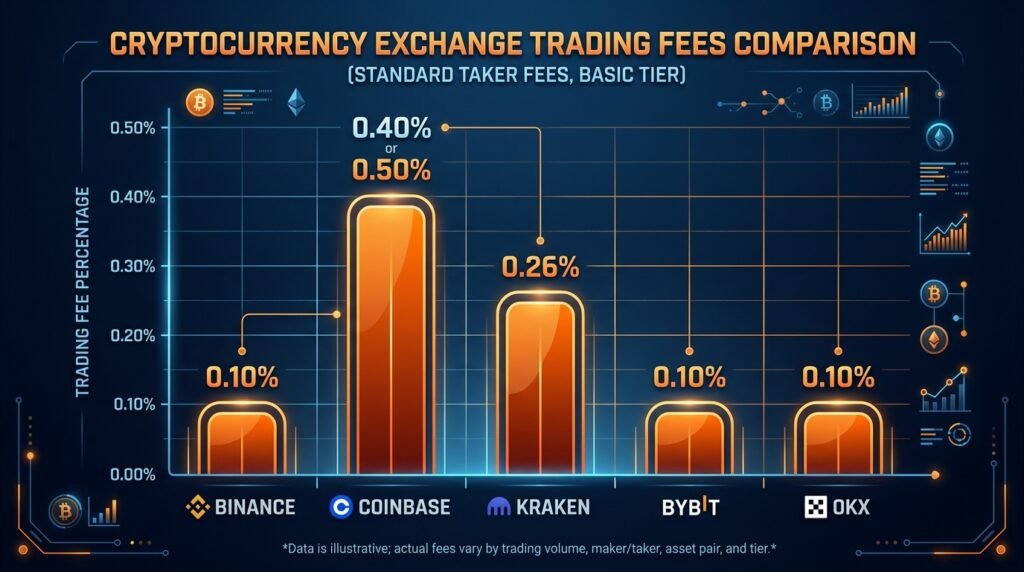
Fee Comparison Across Major Exchanges
| Exchange | Maker Fee | Taker Fee |
|---|---|---|
| Binance | 0.10% | 0.10% |
| Coinbase Advanced | 0.40% | 0.60% |
| Kraken | 0.25% | 0.40% |
| Bybit | 0.10% | 0.10% |
| OKX | 0.08% | 0.10% |
Key Takeaway: Always factor in both entry and exit fees when calculating expected profit. A trade that looks like a 5% gain before fees could be a 4% gain or less after fees on a low-cap exchange.
Crypto Loss Calculator: When the Market Goes Against You
Not every trade is profitable — and that’s okay. What matters is knowing exactly how much you’ve lost so you can:
- Make informed decisions about whether to hold, cut losses, or average down
- Claim tax deductions — in many countries, capital losses can offset capital gains
- Understand your break-even price — the price the asset needs to reach for you to recover your investment
Break-Even Price Formula
Break-Even Price = Buy Price × (1 + Total Fees %)
For example, if you bought ETH at $2,000 with a 0.5% total fee structure:
Break-Even = $2,000 × 1.005 = $2,010
ETH needs to reach $2,010 just for you to get your money back.
Loss Example: LUNA Collapse (2022)
Many investors lost significant capital during the Terra/LUNA collapse. An investor who put $5,000 into LUNA at $80/coin and watched it drop to $0.0002:
- Original investment: $5,000 (62.5 LUNA)
- Final value: ~$0.01
- Loss: ~$4,999.99 (−99.99%)
Brutal — but this loss could be claimed as a capital loss to offset other crypto gains in the same tax year. Knowing the exact figure is essential.
Crypto ROI Calculator: Measuring True Return on Investment
ROI (Return on Investment) is the percentage gain or loss relative to your original investment. It’s the most universally understood metric for measuring investment performance.
ROI Formula
ROI (%) = [(Profit or Loss) ÷ Total Investment] × 100
Crypto ROI vs. Traditional Investments
| Asset Class | Average Annual ROI (2017–2026) |
|---|---|
| Bitcoin (BTC) | ~150% (with high volatility) |
| S&P 500 Index | ~10–12% |
| Gold | ~6–8% |
| Real Estate | ~8–10% |
| Ethereum (ETH) | ~200%+ (with high volatility) |
Note: Past performance does not guarantee future results. Cryptocurrency investments are high risk.
The extraordinary ROI potential of crypto comes with corresponding risk. This is why position sizing — knowing exactly how much to invest per trade — is crucial. A profit calculator helps you simulate different investment amounts before committing real money.
For more on crypto investment strategies, the Investopedia guide to cryptocurrency investing is an excellent foundational resource.
How Crypto Profit Affects Your Taxes in 2026
This is the section most beginner investors overlook — and it can be expensive.
In most major countries, cryptocurrency profits are treated as capital gains and are therefore taxable. Here’s a country-by-country summary:
United States
The IRS treats crypto as property. Your tax rate depends on how long you held the asset:
- Short-term gains (held less than 1 year): Taxed as ordinary income — up to 37% depending on your income bracket
- Long-term gains (held more than 1 year): Taxed at 0%, 15%, or 20% depending on your income
As of 2026, US exchanges like Coinbase are required to report your transactions to the IRS via Form 1099-DA. If you don’t report your gains, you will likely receive an automated notice from the IRS.
United Kingdom
HMRC treats crypto gains as capital gains. The annual Capital Gains Tax allowance is £3,000 (2025/26). Gains above this are taxed at 10% (basic rate) or 20% (higher rate).
Australia
The ATO treats crypto as an asset subject to Capital Gains Tax. A 50% CGT discount applies to assets held for over 12 months.
India
India has a flat 30% tax on crypto gains, with no deductions allowed for losses against other income.
Tax Tips for Crypto Investors
- Keep records of every trade — buy price, sell price, date, amount, and fees
- Use a crypto tax software like CoinLedger, Koinly, or CoinTracker to automate reporting
- Harvest losses before year-end to offset gains
- Consult a crypto-specialized tax professional if your portfolio is complex
For official IRS guidance on cryptocurrency taxes, visit IRS.gov — Virtual Currencies.

Crypto Profit Calculator for Specific Coins
Different coins have different characteristics that affect how you should think about profit calculations.
Bitcoin Profit Calculator
Bitcoin (BTC) is the benchmark. When calculating BTC profit, keep in mind:
- Bitcoin’s 4-year halving cycle historically drives bull markets
- Long-term holders (HODLers) who hold through bear markets have consistently seen profits over 4+ year windows
- The next Bitcoin halving occurred in April 2024; historically, peak prices follow 12–18 months later
Use case: Enter what you paid for BTC and your target exit price. If BTC ever hits $150,000, what would a $5,000 investment be worth? (Answer: approximately $16,000+ depending on fees.)
Ethereum Profit Calculator
Ethereum’s value is tied to DeFi, NFTs, and smart contract activity. ETH calculations should factor in:
- Gas fees, which can be significant for frequent traders
- Staking rewards if you’re running a validator or using liquid staking
- ETH/BTC ratio trades popular among more advanced users
Altcoin Profit Calculators
For altcoins (SOL, BNB, XRP, DOGE, ADA, etc.):
- Higher volatility means profits can be dramatic — and so can losses
- Liquidity matters: thin order books mean your sell order can move the price against you
- Always check fees on the specific exchange listing the altcoin

Common Mistakes When Calculating Crypto Profits
Even experienced traders make these errors. Avoid them:
Mistake 1: Forgetting Fees on Both Sides
Every trade has an entry fee AND an exit fee. Only counting one dramatically overstates your profit.
Mistake 2: Not Accounting for Multiple Buy Orders (DCA)
If you’ve bought the same coin multiple times at different prices, your “buy price” is a weighted average — not the last price you paid. Use a DCA (Dollar Cost Averaging) calculator for these scenarios.
Mistake 3: Ignoring Currency Conversion
If you’re based in the UK, EU, or Australia, your profits are taxed in your local currency. The USD profit and GBP profit may differ due to exchange rate movements.
Mistake 4: Confusing Unrealized and Realized Gains
An unrealized gain is profit on paper — you still hold the coin. A realized gain is profit you’ve actually locked in by selling. Taxes only apply to realized gains (in most countries).
Mistake 5: Not Recording the Date of Purchase
The date matters for tax purposes (short-term vs. long-term capital gains). Always log the date alongside price and amount.
Mistake 6: Using the Wrong Price Basis for Received Crypto
If you received crypto as a gift, through staking rewards, or as payment for work, the cost basis is the fair market value at the time of receipt — not zero.
Pro Tips for Maximizing Your Crypto Returns
Beyond calculation, here’s how savvy investors use profit data to make better decisions:
Set Clear Profit Targets Before You Buy
Before entering any trade, run the numbers: “If this coin doubles, what do I make? If it drops 50%, what do I lose?” This mental exercise separates disciplined traders from gamblers.
Use the 2% Rule
Many professional traders risk no more than 2% of their total portfolio on a single trade. A profit calculator helps you size positions accordingly.
Factor in Tax Efficiency
Holding an asset for over 12 months can cut your tax rate in half in many jurisdictions. Sometimes it’s more profitable to hold a winner than to sell and pay short-term tax rates.
Track Your Overall Portfolio ROI, Not Just Individual Trades
A single winning trade can make you feel like a genius. Your overall portfolio ROI tells the real story. Connect your wallets to a portfolio tracker for the complete picture.
Reinvest Profits Systematically
Compound returns are powerful. If you reinvest a portion of each gain, your profit calculator inputs will change dramatically over time — in a good way.
For deeper learning on crypto trading strategy, the CoinGecko Crypto Research Hub offers excellent free educational resources.

Frequently Asked Questions (FAQ)
Use this formula: (Investment − Investment Fee) × (Sell Price ÷ Buy Price) − Investment − Exit Fee. Alternatively, enter your numbers into a free crypto profit calculator and get the result instantly.
Yes, in most countries. In the US, crypto profits are taxed as capital gains — at up to 37% for short-term gains (held under 1 year) and 0–20% for long-term gains (held over 1 year). Always consult a tax professional for advice specific to your situation.
There’s no single answer. Bitcoin has historically averaged well above 100% annually over multi-year bull cycles, though with enormous drawdowns in between. Compare your crypto ROI to your next best alternative investment to gauge whether the risk is worth it for you personally.
Multiply your buy price by (1 + total fee percentage). For example, if you bought BTC at $50,000 with a 0.5% total fee: Break-even = $50,000 × 1.005 = $50,250.
Yes — use the weighted average cost basis. Add up your total amount spent and divide by total coins acquired. This gives you an accurate average buy price across all purchases.
Realized gains occur when you sell — you’ve locked in the profit and it’s taxable. Unrealized gains are paper profits while you still hold the asset — no tax event has occurred yet.
Yes. In most tax jurisdictions, staking rewards are treated as ordinary income at the fair market value when received. Any subsequent gain when you sell those staked tokens is also taxable as a capital gain.
Capital losses from crypto trades can offset capital gains in the same tax year, reducing your overall tax bill. In the US, if your losses exceed gains, you can deduct up to $3,000 against other income, with remaining losses carried forward.
Conclusion
A crypto profit calculator is not just a convenience — it’s an essential tool for any serious cryptocurrency investor. Whether you’re calculating how much you made on your first Bitcoin purchase, modeling the potential upside of a new altcoin, or preparing your annual tax return, having accurate profit figures is non-negotiable.
The formula is straightforward: investment in, fees out, sell price divided by buy price — and you have your answer. But the implications of that answer touch everything from your trading strategy to your tax liability to your financial goals.
Use the calculators we’ve recommended, track your trades from day one, account for fees on every transaction, and consult a tax professional if your portfolio is growing. The investors who treat crypto like the serious financial instrument it is — and do the math — consistently outperform those who trade on gut feeling alone.
Ready to calculate your crypto profits right now? Use the free calculator at the top of this page, or explore CoinCodex’s Profit Calculator for advanced features including investment growth projections.
Checkout Real Time Rates.